 Ezra listening intently as Dr. Jesse explains the procedure
 We decided to see Dr. James Jesse in San Bernardino, CA. It was a four hour drive for us, and to ease the stress of travel, Brad, Ezra, and I drove down the day before and stayed in a hotel.
During my Virtual Adventures in Tie-Land, I met a LLL Leader and IBCLC who lives about an hour south of me, Julie Huisjen. She was the one who really planted the idea of visiting Dr. Jesse and seeking laser revision for the ULT and PTT, as opposed to scissors for the PTT alone. As much as I didn’t want to travel that far, I came to the realization that a trip to Dr. Jesse was the way to go. As a bonus, Julie asked if she could come and observe the procedure, and I was pleased for the opportunity to meet her and have additional support.
Julie was waiting for us when we arrived at the office, and although we just met, I was grateful for her presence. When Dr. Jesse came to our room he was friendly and up-beat. He examined Ezra and agreed that we could benefit from having the ties revised. He explained the procedure, answered questions, and was appreciative of Julie’s and my breastfeeding background.
During my Virtual Adventures in Tie-Land, I met a LLL Leader and IBCLC who lives about an hour south of me, Julie Huisjen. She was the one who really planted the idea of visiting Dr. Jesse and seeking laser revision for the ULT and PTT, as opposed to scissors for the PTT alone. As much as I didn’t want to travel that far, I came to the realization that a trip to Dr. Jesse was the way to go. As a bonus, Julie asked if she could come and observe the procedure, and I was pleased for the opportunity to meet her and have additional support.
Julie was waiting for us when we arrived at the office, and although we just met, I was grateful for her presence. When Dr. Jesse came to our room he was friendly and up-beat. He examined Ezra and agreed that we could benefit from having the ties revised. He explained the procedure, answered questions, and was appreciative of Julie’s and my breastfeeding background.
 Ezra's laser action
 I sat in the dental chair with Ezra’s head on my left shoulder. I held my arms over Ezra’s chest, thereby pinning his arms but allowing his feet freedom to kick. Dr. Jesse numbed Ezra’s mouth, and then we sat and chatted for a few minutes to allow the anesthetic to take effect. Dr. Jesse was very personable with a great sense of humor. We asked to video the procedure and Dr. Jesse welcomed it -- that way I could watch it later.
Two assistants helped, one holding Ezra’s head behind us, and another to the right of us who was holding the spit-sucker (I am sure there is a technical term for that!). Once started, the actual procedure took less than 5 minutes. Ezra cried and moved a lot, but I knew he was probably more bothered by the restraining of his head than the laser surgery happening in his mouth. There was a little blood to be blotted with gauze, and that was it!
Two assistants helped, one holding Ezra’s head behind us, and another to the right of us who was holding the spit-sucker (I am sure there is a technical term for that!). Once started, the actual procedure took less than 5 minutes. Ezra cried and moved a lot, but I knew he was probably more bothered by the restraining of his head than the laser surgery happening in his mouth. There was a little blood to be blotted with gauze, and that was it!
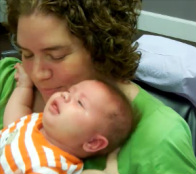 All done!
 I sat up and looked at my fat-lipped baby as Dr. Jesse said, “From here on out things will get better.” I asked how soon I could nurse him, and smiling Dr. Jesse answered, “Moms like you nurse right away.” We tried, but Ezra’s numb mouth made latching difficult. I decided we would try again later. Dr. Jesse said babies cry for about 8 minutes post-revision, and then they are usually okay. We happened to have the appointment before lunch, and Dr. Jesse was kind enough to talk to us for another 30 or 40 minutes, generously sharing information, stories, and jokes.
 Getting ready to try and nurse
 We went to lunch and I nursed Ezra for the first time. I could already see a part of his upper lip turned out that I had never seen before – it wasn’t a huge flanging or anything, but it was something. I didn’t notice relief, though – if anything it felt a little tighter (read: worse).
Ezra was acting fine when we hit the road and headed for home. 30 minutes from home he began crying inconsolably. We stopped at Costco and I tried to nurse him in the car. He would attempt to latch, but then he acted like his mouth hurt (which I could believe!). I was worried about him not nursing, but they told me at the office he might not want to nurse too much in the first 24 hours, so it wasn’t a surprise. I decided at that point to give him Tylenol, we walked around Costco for about an hour, and then he settled down to nurse. I still couldn’t tell a difference in my pain level.
Ezra was acting fine when we hit the road and headed for home. 30 minutes from home he began crying inconsolably. We stopped at Costco and I tried to nurse him in the car. He would attempt to latch, but then he acted like his mouth hurt (which I could believe!). I was worried about him not nursing, but they told me at the office he might not want to nurse too much in the first 24 hours, so it wasn’t a surprise. I decided at that point to give him Tylenol, we walked around Costco for about an hour, and then he settled down to nurse. I still couldn’t tell a difference in my pain level.
 Melting into his cousin Caleb
 I gave him one more dose of Tylenol later that evening, and by the next afternoon, he seemed back to normal. Dr. Jesse’s office instructed us to stretch the upper lip and sweep under the tongue once every hour Ezra was awake. We went to a chiropractor the next day, and I have never seen Ezra so melty afterwards, if that’s a word.
Ezra’s “reflux” stopped almost overnight. He would still spit up, but it was nothing like it had been before. His clicking was mostly gone. That strange (cute) way he had of chewing up to latch on the nipple with a grimace on his face was gone, as was his way of sliding off the nipple while nursing. He seemed to be doing better, but I was still waiting…
Sometimes he didn’t mind the stretching, other times he hated it. One thing I figured out was to do the stretches as far away from a feeding session as I could, or we might have a hard time nursing afterwards.
One week passed and although Ezra seemed happy, I wasn't noticing anything much more than not having to hold the breast for him every time he nursed. I am so grateful for Tongue Tie Babies Support Group, there I received realistic ideas about how things might shape up for us over time. Although some women note instant relief after their babies' revisions, it seemed to me for every one who had that experience, there were 4 women who said it took many weeks for full effect. If I hadn't known that, I would have felt the surgery was a waste of time and money. So I kept up with the exercises and tried to encourage wider and deeper latching.
Speaking of money, in my haste to get this done I didn't ask Dr. Jesse's office the price of the procedure or what my insurance might cover. As Ezra was a newborn, I hadn't thought to sign him up on our dental plan, which would have covered the surgery. I was surprised to have to pay out-of-pocket for the surgery -- it was $400. I was happy to do it (although I will be even happier if our medical insurance reimburses us some!). Realistically, that is an affordable price for this procedure, in my opinion.
Two weeks passed and I wasn't feeling better. The nipple shape still showed some compression stripes after nursing. Before the revision, it was more painful to nurse on the left side; after the revision, it was more painful on the right side. This was not a miracle fix for me. Again, I was uplifted by the stories of other mothers; I tried to be patient, continued with the stretches, and kept correcting shallow latch-attempts.
Ezra’s “reflux” stopped almost overnight. He would still spit up, but it was nothing like it had been before. His clicking was mostly gone. That strange (cute) way he had of chewing up to latch on the nipple with a grimace on his face was gone, as was his way of sliding off the nipple while nursing. He seemed to be doing better, but I was still waiting…
Sometimes he didn’t mind the stretching, other times he hated it. One thing I figured out was to do the stretches as far away from a feeding session as I could, or we might have a hard time nursing afterwards.
One week passed and although Ezra seemed happy, I wasn't noticing anything much more than not having to hold the breast for him every time he nursed. I am so grateful for Tongue Tie Babies Support Group, there I received realistic ideas about how things might shape up for us over time. Although some women note instant relief after their babies' revisions, it seemed to me for every one who had that experience, there were 4 women who said it took many weeks for full effect. If I hadn't known that, I would have felt the surgery was a waste of time and money. So I kept up with the exercises and tried to encourage wider and deeper latching.
Speaking of money, in my haste to get this done I didn't ask Dr. Jesse's office the price of the procedure or what my insurance might cover. As Ezra was a newborn, I hadn't thought to sign him up on our dental plan, which would have covered the surgery. I was surprised to have to pay out-of-pocket for the surgery -- it was $400. I was happy to do it (although I will be even happier if our medical insurance reimburses us some!). Realistically, that is an affordable price for this procedure, in my opinion.
Two weeks passed and I wasn't feeling better. The nipple shape still showed some compression stripes after nursing. Before the revision, it was more painful to nurse on the left side; after the revision, it was more painful on the right side. This was not a miracle fix for me. Again, I was uplifted by the stories of other mothers; I tried to be patient, continued with the stretches, and kept correcting shallow latch-attempts.

Around three weeks, I started to feel a shift. One thing I have done since the very beginning with Ezra was talk him through our nursing sessions. Although this may seem silly, as in our family we already decided our dog is smarter than our baby (for now!), there is evidence that shows babies can learn when moms talk to them (parent–infant synchrony, or affect synchrony). The left brain is the technical, watch-the-clock, math side, while the right is the emotional, easy-breezy side. It isn't really possible to get our babies to learn algebra or memorize a linear sequence of events, but it is possible for babies to absorb behaviors and coping strategies connected and displayed by their mothers or other caregivers. It's like a baby's first positive self-talk -- I let him know, not only with words but also with emotions and facial/body language, how we can improve our relationship. It can't hurt, right? I am not attributing our breastfeeding success entirely to this concept, but I feel it certainly can't hurt!
 Laid-back breastfeeding enables face-to-face interaction
 How this looks: When Ezra would latch well, I would praise him and relax and smile. If his latch needed adjustment, I would say something like, "Okay, let's try that again. Open you mouth wider so it doesn't pinch."
The most fun for talking and nursing was in a laid-back position while I was on my bed. I would lie in bed and prop Ezra's upper half on my upper half, with his legs basically standing on the mattress. Babies have about 20 reflex responses that kick in when they are on their bellies as opposed to their backs, and one of these is called, aptly, "stepping." As Ezra would step to get closer to the nipple, reaching it chin first and then latching over the nipple with his upper jaw, his upper lip would naturally be in an ideal position to flange open. We were also en face, ready to engage and exchange smiles, head bobs, and happy eyes.
By four weeks (two days ago) I could safely say I believed we were cured. So inappropriate in an essay, but I feel that statement deserves a smiley face. This is where I go all Dorothy on you to figure out what I learned from my journey:
1. Find support. It wasn't until I connected with the Facebook group that I found experienced, real-life helpers in my area. Not only was this beneficial in assessing our situation, it also led me to the best practitioner for the job. If you haven't already met with an IBCLC experienced in ties, a group like Tongue Tie Babies Support would be a good place to ask for referrals in your area.
2. Get a second opinion -- and a third, and a fourth -- until you feel your gut agrees with what the professional is telling you. You have inner wisdom -- use it! Everything we are told is filtered through someone else's perception and experience. The first idea to pop into one practitioner's head may not be the same thing to pop into another's. In healthcare, the difference between wrong and right can sometimes be a simple difference of opinion.
3. Don't judge a book by its cover. And don't let your healthcare practitioner do the same. This means, the appearance of the tie/s shouldn't be more important than how the tie/s affect breastfeeding for mom and/or baby. The first doctor we saw (who was also an IBCLC) said Ezra's tongue-tie did not look severe, but due to the clicking, sliding, and pain, warranted treatment. If your practitioner doesn't value function over form, you may want to seek another opinion.
4. Continue to work with your baby patiently. It stands to reason the longer your baby has nursed with the tie/s, the more time he may need to get to a better place after revision. Resolution of the ties themselves is only the first part of the process; for continued progress, stretches help avoid reattachment that could come with normal healing. Your baby may also need to relearn how to breastfeed with this new and improved equipment, and that is where working with an experienced IBCLC can be integral, as well as getting bodywork done for your baby. I also chose to do tongue exercises with Ezra that are found in Breastfeeding Answers Made Simple: "Walking Back on the Tongue," and "Pushing the Tongue Down and Out."
5. Add your baby to your dental insurance. Or, be prepared ahead of time. It may just be me who makes that mistake ever, but still, I wish someone would have reminded me of that 4 weeks and, oh, 3 days ago. :)
The most fun for talking and nursing was in a laid-back position while I was on my bed. I would lie in bed and prop Ezra's upper half on my upper half, with his legs basically standing on the mattress. Babies have about 20 reflex responses that kick in when they are on their bellies as opposed to their backs, and one of these is called, aptly, "stepping." As Ezra would step to get closer to the nipple, reaching it chin first and then latching over the nipple with his upper jaw, his upper lip would naturally be in an ideal position to flange open. We were also en face, ready to engage and exchange smiles, head bobs, and happy eyes.
By four weeks (two days ago) I could safely say I believed we were cured. So inappropriate in an essay, but I feel that statement deserves a smiley face. This is where I go all Dorothy on you to figure out what I learned from my journey:
1. Find support. It wasn't until I connected with the Facebook group that I found experienced, real-life helpers in my area. Not only was this beneficial in assessing our situation, it also led me to the best practitioner for the job. If you haven't already met with an IBCLC experienced in ties, a group like Tongue Tie Babies Support would be a good place to ask for referrals in your area.
2. Get a second opinion -- and a third, and a fourth -- until you feel your gut agrees with what the professional is telling you. You have inner wisdom -- use it! Everything we are told is filtered through someone else's perception and experience. The first idea to pop into one practitioner's head may not be the same thing to pop into another's. In healthcare, the difference between wrong and right can sometimes be a simple difference of opinion.
3. Don't judge a book by its cover. And don't let your healthcare practitioner do the same. This means, the appearance of the tie/s shouldn't be more important than how the tie/s affect breastfeeding for mom and/or baby. The first doctor we saw (who was also an IBCLC) said Ezra's tongue-tie did not look severe, but due to the clicking, sliding, and pain, warranted treatment. If your practitioner doesn't value function over form, you may want to seek another opinion.
4. Continue to work with your baby patiently. It stands to reason the longer your baby has nursed with the tie/s, the more time he may need to get to a better place after revision. Resolution of the ties themselves is only the first part of the process; for continued progress, stretches help avoid reattachment that could come with normal healing. Your baby may also need to relearn how to breastfeed with this new and improved equipment, and that is where working with an experienced IBCLC can be integral, as well as getting bodywork done for your baby. I also chose to do tongue exercises with Ezra that are found in Breastfeeding Answers Made Simple: "Walking Back on the Tongue," and "Pushing the Tongue Down and Out."
5. Add your baby to your dental insurance. Or, be prepared ahead of time. It may just be me who makes that mistake ever, but still, I wish someone would have reminded me of that 4 weeks and, oh, 3 days ago. :)

 RSS Feed