 You know how they say, “Wear sunscreen? Well, let me be your cautionary person-writing-this-blog-post and say, up front, WEAR YOUR SUNSCREEN. On that note of “The more you know” (did you just hear the music?), let me also share that we need to watch our skin for more than just those changing moles we always hear about. Yesterday I had a Mohs procedure on a superficial basal cell
carcinoma on my face (yes, skin cancer). My only clue this was something that needed attention was the fact that, all summer, I had this spot on my nose that would scab up for a week or so, and then heal. Scab, then heal. Scab, then heal. It was a shiny piece of flesh-colored skin that maybe looked a bit callused – no pigmentation, no mole appearance, just a regular area of skin that looked and
behaved a little differently. A visit to my dermatologist revealed it was problematic, and that leads us to the Mohs procedure.
In order to fully get the root of the tumor, a Mohs surgery can be lengthy. The skin is numbed, the surgeon draws, and then they cut. They take that piece of tissue and essentially put a cross-hair on it,
mapped to match the area from where it was removed. This is examined to see if all the bad cells are gone (I never said I was an expert). If they see anything remaining on the sample, they know exactly where the offending tissue lies; my surgeon had to come back one more time in true, if-at-first-you-don’t-succeed fashion. There is a wait time of 30 minutes between each sample, which is why this isn’t generally an in-and-out procedure.
After this was all taken care of, I expected my doctor would just swab some antibiotic ointment and slap a cutesy Band-Aid on and that would be it. But I was wrong. I actually had to go to a different part of the building. “I’ll meet you over there, “ my handsome, thirty-something, Mediterranean (Middle-Eastern? Spanish? Who knows) hunky doctor said. Then a nurse walked me through some doors, shoved some things into my arms, and said, “Go ahead and put your clothes in the bag.” Um, what? I am just getting
my nose bandaged!? What’s going on?
In the shock of suddenly realizing I needed to strip down, I couldn’t remember if the gown was to open in the front or the back. I tried it one way, spun it around, then twisted it back the first way. Finally with it half on, fabric clenched in my hands to cover my behind, I stuck my head out to call, “Hey, what’s the story on the gown? Open in the front or the back?” The back, definitely the back.
I continued with my booties and the ever-lovely surgical hair-net thing. I was placed in a bed and my nurse brought me a warm blanket -- other accoutrements included an automatic blood pressure cuff, and a pulse ox on my right index finger. My nurse sat and chatted with me for a bit, over such everyday topics as allergies to any drugs (none), was I supposed to take my bra off, because I did (there are so few places outside of one’s own home where I can do this, so why not? But no, it was not required), and the fact that we both were breastfeeding mothers (can’t remember how that came up).
I was actually wheeled, wheeled, I say! into the surgery (that sounds so Doc Martin, but unlike the European definition, this was the place in the surgery center where they do surgeries, not the office where docs do visits). When my doctor came in, I was kind enough to remind him that it had been a couple hours since last my nose was bee-stinged beyond feeling, so I would love some more drugs to numb that region. Here is the comment that started it all: “I think I have a pretty high pain tolerance, but I don’t want to feel this if I don’t have to.” His response was, “Oh, why do you think that?” I shared I had 4 babies with no pain meds. He and the two nurses all gasped. Oh, I had one more coming, “And the last one was born at home.” My nurse fainted to the floor.
Okay, not really. But I they were still abuzz with a lot of questions, that all sounded like “Why?” (Let me come down off my high-horse now.) “I wasn’t planning to have my first without pain meds. In fact, I said, ‘I have seen women give birth naturally, I think it’s pretty crazy; I am totally getting an epidural.’ Well fast-forward to an unneeded induction, and I wasn’t able to get an epidural. My fear of throwing up won out over my fear of having a baby, so I somehow was able to give birth to my first baby without an epidural or narcotics. It took some time to work through mentally, but eventually, I was happy about
it.”
 By this time in the surgery, my bed has been lifted up, the doctor has cleaned the left, upper quadrant of my face with iodine, my eyes stinging from the closeness of the fumes, and my face has been covered with a piece of paper with a circle cut out of it so only my nose is exposed.
I continued on…“With my second baby, I wondered what could birth be like if I actually planned to not use any medications? I got a midwife who delivered in the hospital, and I waited to go into labor on my own. Third baby, the same. Fourth baby, we moved here, there were no hospital-based midwives, so I found a licensed midwife who came to our home to help us have our baby there.”
“Why would someone choose to not have pain medications? It is painful to have a baby!” he stated, with much authority (at this point, I did question how he knew this, had he ever experienced it? To which
he conceded, no, but he had seen it a lot). So I asked him this: “Why would someone choose to climb Mt Everest?”
“That’s different,” came his reply, “I can understand that. You want to see what you are able to
accomplish physically. You are challenging your body, working toward a goal...” My pulse-ox’d finger interrupted him, pressing, pressing on its imaginary quiz-show buzzer – or maybe it was my voice -- “DING DING DING! You got it!”
I couldn't see him because my face was covered, but his hands paused in their stitching. “I…could see that,” he came around, slowly. The hands resumed their stitching. “I am not sure what the big deal is about drug-free birth though. There is so much pressure to have a natural birth, but we don’t have the
longitudal studies that show epidurals, or even c-sections, have life-long health risks.” On the spot, under the cover of plastic-y-paper, I couldn’t think of anything incredible to counter with. I did cite that babies born via cesarean birth have higher levels of allergies, and that was about all I could think of.
I joined him, then, because I do feel it’s the truth, “There is a lot of pressure for women to go all natural, I see that. It is very similar to the pressure we put on women to breastfeed -- ” Okay, this is when he cut me off!
“ – But those stats are there, we know breastfeeding is beneficial, we have that information.” Interesting!
Super, hard-cord breastfeeding advocate, not so much on the normal birth platform! I decided, since I
couldn’t present any compelling evidence-based studies or data from Cochrane, I would just keep it simple and stick with his line of thinking. “We are humans, though, and we know as mammals, breastmilk is the optimal, species-specific diet for our newborns.” He agreed. "Doesn’t it stand to reason, then, that
vaginal birth, as unhindered as possible, is the norm for us as well? And even though we have the option for epidurals and cesarean births, that vaginal birth would provide the most optimal way for our babies to be born?” Honestly, I can’t remember what he said after that, only I know he wasn’t trying to refute anything.
The cover was lifted off my face and it was time for the nurses to step in and dress my wound. As he stepped back to let them take over, he asked, “Are you a medical professional?” I paused before my
answer, and then said, “No, I am a birth doula, a childbirth educator, and a La Leche League Leader.” He shook my hand, nodded his head to me, and then departed to fill out my discharge papers.
What fun! It made all those 5 bee stings to the nose worth it. I can actually say, due to that conversation, I rather enjoyed my day at the dermatologist. The staff was incredible and attentive (and I am assured my scar will be minimal). You never know where great birth conversations will happen! But the opportunity to have 20 minutes, one-on-one with a surgeon (albeit a derm surgeon), was pretty darn fun.
 This is long! Be warned!
I think when a person in is a position to serve a woman while she is in labor, that person should have required training every few years, like a recertification, on what it feels like to have a baby. I am not certain how this certification could be obtained, virtual reality plus some sort of pregnancy suit? Actually having a baby? I haven’t figured out the logistics, but I have recently had a recertification of my own, and that is called, my fourth child.
This fourth pregnancy was a surprise. Technically, I got pregnant at a time when no one would be able to get pregnant – only I guess more like I got pregnant at a time I felt I was highly, highly unlikely to get pregnant. My last menstrual period was June 10th. I did not get pregnant until July 13th at the earliest (a time when I was waiting for my period to start), to July 20-ish at the latest; looking at the date he was born now (April 6th), July 13th seems closer to the target date…we were on vacation.
I had lots of irritable contractions combined with irritable baby movements (probably more of the latter versus the former) that would happen around 10 pm to 1 am. The week before labor began I pretty much experienced these every night and I hated them. During these times, I would have waves of panic and anxiety about the reality of actually having to go through the birth process again, and I was always grateful when they were over and I could finally climb into bed.
Friday the 5th of April was pretty normal except I had two very serious bouts of grumpiness that made me feel deeply in touch with someone who was (hopefully!) going to start labor soon -- it was like total,
irrational, not-triggered-by-much anger that switched on so fast, I knew it was something else with some other root than just me being moody.
We had pizza for dinner, and like I had for the last week, I restrained myself from eating too much (“If labor starts tonight I don’t want to be too full,” was my rationale). I had two pieces and then cut myself
off. I took a little nap in bed, which I hoped would actually be “going to bed,” but I woke up at about midnight when I couldn’t ignore the antics of Wild Baby any longer. I watched TV a little and sat on the ball to try and bounce my guy into a calmer state. At 1 am I decided to watch the last episode of Mad Men on Netflix so I would be ready for the new season, with the intention of going to bed after that.
At 2 am, just when I was settling into sleep, I realized I was contracting, and these contractions felt different. They came 5-6 minutes apart, were totally manageable, and lasted about 40 seconds. I tried to sleep, but I was also mindful of needing to recognize true labor so I could get my sister and my mom on the road from two and a half hours away if this really were it.
Everyone was asleep, and as long as I was okay, I felt no need to wake them. I was feeling hungry, so I ate half a lemon Chobani (again, not wanting to eat a lot) in the morning quiet. I did call my sister at 3 am to let her know it was go-time. I labored longer, in the quiet of my living room, tending to small errands and tasks between contractions. At 4 am I woke Brad up to tell him I was in labor. He came out to the living room and asked, “What can I do?” and I immediately answered, “Take the recycling out, it’s driving me crazy and I have contemplated doing it myself for the last 2 hours.” I was hoping he would just lie back down on the couch and snooze a little, but he was up and ready to go.
I thought I would wait to call my midwife until 5 am, but at 4:30 my contractions began to get stronger and longer and closer together, just as they should, and I finally had some show. I phoned Linda to let her know I was in labor. She asked me a few questions, and then said she would be over soon. She lives about 40 minutes from us.
At 6 am, Linda arrived, and things were beginning to feel real. We had our tub set up in the dining room and I was feeling a pull to climb in, but I didn’t want to stall labor if I wasn’t that far along. I asked Linda to check me and she said I was 3 centimeters (“Not quite active labor!” I thought with a little disappointment), about 90% effaced, baby maybe at -2 station? I can’t remember that part. I mentioned I wanted to get in the tub, but I should probably try the shower instead (so gravity could keep helping my labor), and Linda agreed.
I got in the shower, and I really don’t know how long I was in there. The water felt great on my belly and during contractions I would swing from side to side so the water could fan over me. In between contractions I alternated putting my foot up on the side of the shower to lunge, in case my baby was posterior like his two brothers before him. Soon I found I had to vocalize during the contractions. I was in the bathroom alone and I had a lot of time to think. The thought that kept coming back to me was, “All is as it should be,” which was part of a prayer Brad had said earlier in the week when I was feeling really overcome with fear. I rubbed my belly and talked to the baby and told him to hurry, it all felt like it was happening in slow motion.
When I got out of the shower it was about 7 am and Linda checked me again. I was 5 centimeters. I went straight for the tub at that point, dropped my towel, and climbed in.
Jacob and Jonas were awake and had been for a while. Soon Isaac woke up and came straggling out of his bedroom in his standard sleeping attire – undies and a t-shirt. Brad told him we had company and he might want to put clothes on. Before Isaac woke up I remember Brad asking Jonas if he knew why Linda was at our house so early? Jonas admitted he didn’t, and we made a joke about Linda just coming for an early-morning visit. Brad then said, “Your mom is going to have the baby today.”
I looked to the tub for the relief it had brought in the past; with both Isaac and Jonas I got into the Jacuzzi tub at 5ish centimeters and after an hour was at 9ish centimeters, and I was hoping for the same, with the addition of having the baby in the water. After 30 or 40 minutes it seemed the tub wasn’t going to work as I had planned. I had intense pain in my lower abdomen to the point of not being able to sit in a relaxing position, so the whole time I was in the water I had to be on my hands and knees, and I didn’t want to stay that way much longer. Also, Brad started making pancakes in the kitchen.
At about 7:45 my mom, sister Shiela, and her two boys arrived. I headed to my bedroom, finished with the tub. Linda had set things up around the pool in preparation of a water birth, so some rearranging was in order, moving things to my room, getting equipment ready if needed. Once in my room it was just Linda, my mom, Shiela, and I. Brad had the boys going with pancakes and if they were making any noise, I sure didn’t hear it.
I asked someone to bring the piano bench into my room as I was laboring standing up, and I wanted to continue to lunge in case I had a malpositioned baby (which I don’t think he was, but I was a little gun
shy).
I think I had Linda check me again, and I think I was 7 centimeters? I am not really clear on this part. I wasn’t ready to sit down, so I continued to labor standing up. Shiela was a super doula – she would squeeze my hips during my contractions, and it brought so much relief! One thing I know about that double-hip squeeze is, it is hard to do when you have to press your arms together at the height of a woman’s hips – you get tired fast, and the laboring woman usually doesn’t want you to stop. If the
mom can get on her hands and knees on the floor, you can squeeze her hips with your own inner knees by straddling over her back, but I didn’t even want to try or offer that as I didn’t feel good in that position.
Over and over, a contraction would come, and I would tell Shiela, “Hips, hips, hips,” and she would start
squeezing.
In reality I have no idea what kind of time span this all happened in, I say over and over, but maybe it was only about 5 contractions? Or maybe it was 10?
I did finally sit on the bed for a bit. I remember taking my watch off and handing it to Shiela with the feeling that this was taking too long. I know for a fact I wasn’t looking at my watch or paying attention to how long it was taking in a linear fashion, but it was more some sort of symbolic resignation that I
would try to just flow with the timetable my body and baby presented even though I am as impatient as they come; in the last picture of me with my watch on, I see the time is 8:55 am.
I decided to visit the toilet. I spent a couple of contractions there, and Shiela was with me. She said my noises changed and she knew I was getting closer. As I sat laboring on the toilet, I opened the shower door next to me and contemplated getting back in -- I was looking for anything to comfort me at this point. Then I decided to see if I could feel anything inside of me, so with one finger about one knuckle in I was shocked to find something! “Is that a head?” I asked. But then I realized it was a bulging bag of water, with a head behind it. After all the years of hearing practitioners say, “I feel a bulging bag of water” (which I did remember Linda saying when she checked me last), I finally knew what that felt like and what it meant. I think I almost gingerly hopped off the toilet at that point, feeling remotivated.
I had one contraction standing up, with Shiela at my hips. Then I had another, and my water exploded all over the floor. There was a little meconium but Linda said it looked old and there was no reason for concern. I finally climbed into bed.
At this point I knew it would soon be time to push. I suddenly had the need for Brad to come and be with me, so I called to him and patted the side of the bed next to me, I just wanted him to sit with me and be near. Shiela was on the other side of me, and Linda was at the foot of the bed. My mom was by the door, ready with the camera, and the boys were in the living room playing Legos (again, I never heard anything from the boys, and there were 5 of them. Actually, I think after they ate pancakes they walked to the park with the dog to play for a bit. But I do know when the baby was born, they were playing Legos in the living room).
I did begin pushing at some point, and Linda said I still had a rim of cervix and she was going to try and move it, and I was totally fine with that because if anything was holding this baby up, I wanted it gone. So for a couple of contractions she worked on that and I guess it went away. I was pushing with such intensity but it felt fruitless. I truly felt nothing moving or changing and I imagined pushing forever
and not making any progress. It was at this point that I remember thinking, “I should have gone to the hospital so I could have the drugs!” (Interestingly enough, when I had my babies in the hospital, I never thought to ask for drugs, because I know if I had had the thought, I would have asked; maybe at home when it is not an option, my brain safely went there, just as a way to cope and vent.) Brad and Shiela were helping me pull my legs back during the pushing. Instead of rolling my chin to my chest, which I have helped women remember who-knows-how-many-times, I arched my head back against my pillows. I also had my body twisted in some way, crooked a little. Linda gently reminded me to get better aligned (with words and heart I could understand at that point), while giving me positive encouragement for this task I had to undertake.
Linda! What else could you want from a midwife? Really, not one thing. As a doula, I get really uncomfortable when people say, “Stacie, I couldn’t have done it without you.” Because, come on, you could have, and you would have. I don’t want anyone’s birth experience to have me entangled as an
essential ingredient; it should be all about the mom and her family, not me. But I have to concede that
when the right person is helping you with the right words and attitude and presence and spirit, it helps make the experience even more amazing, if that is possible. When you have the right midwife, the feeling is similar to being in your own home – the comforts of being in your own bed, using your own bathroom, lunging on your own piano bench – Linda was a natural extension of that. It felt right that she be here, in our home, unobtrusively watching over the birth of our baby.
The support Shiela gave me was also invaluable. Family members don’t always make the best doulas.
Shiela actually has taken a DONA-doula training, and that coupled with what she knows about me (just about everything), made her perfect for the job. She stayed by my side, she gave me verbal encouragement, she wished she could help me more. The truth of the matter is, only the mother can have the baby, but she doesn’t have to be alone while she is having her baby. I will forever treasure that my sister was there to support me during one of the most intense experiences of my life.
Pushing was hard, it was really hard – it seemed harder than it ever had been. I know I was lost in my head, and in there, the storm was raging. Every push came with screams, I hate to say it. I have never screamed with any of my other babies. And also, I cried, which was something new for me. In hindsight I probably could have pushed more effectively keeping those screams to myself, but they just came out. I know the boys didn’t appreciate the noise (although they all later admitted they weren’t scared), I am thankful my neighbors didn’t call the police, and the screaming is not my favorite thing about the birth video – oh well!
After so much pushing (again my sense of time is really off here), finally his head emerged. I felt his head with my hand, but it really didn’t mean anything to me, I just wanted the rest of him out! I pushed for one or two more contractions, maybe three, and then his shoulders popped and he tumbled out on a
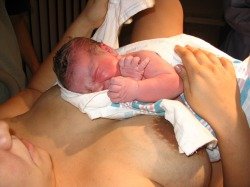
wave of fluid and tons of baby poop. Linda helped bring him to my chest, all the while rubbing him and talking to him and watching him carefully. I was so relieved and instantly went from that person experiencing the very hard work of pushing toward a goal, to that mother experiencing her baby
for the first time. I was rubbing him and toweling him off and just taking him in, my body relieved of the burden with the prize in my arms. He was born at 9:42 am.
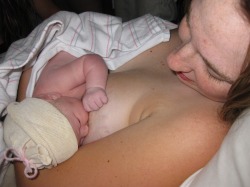
We all watched as he turned from purple-y to pink. His apgars were 8 and 9. Very soon after birth he wanted to nurse and he seemed to know just what he was doing. The boys peeked in one by one, only appearing mildy interested (we had two 13 year olds, two 11 year olds, and one 7 year old), and then backing out of the room again.
There were lots of things in the birth kit we didn’t use. My perineum didn’t need massaging, which Linda was prepared to do. We didn’t need the bulb syringe to suction the baby’s airways. There are lots of Chux pads that didn’t get used. Everything just happened easily and well, as it so often can when left to its own devices. I am sure the level of comfort and security factored into that for me as well. I am still struck by how ordinary things were and how extraordinary they were. Within a couple hours I was back in my shower. A little while later I threw a load of laundry in. My mom bought donuts and I happily ate three. Our new (nameless) baby was being admired and touched and held by his cousins and brothers and dad and aunt and grandma, while also nursing and visually taking in all he could. In many ways it was like a normal Saturday morning at home, but then, it was also like some rare, high holy day, calm with introspection, peace and joy.
Ezra Christian was 8 pounds, 1 ounce. There was much debate about his name – the other choices were Benjamin, Ruben, and Abraham. He was born on what we in the LDS religion believe to be Christ’s birthday, and also the day the LDS religion was restored; Christian is my brother’s middle name, and we
felt it appropriate for Ezra as well.
Moving through that birth, I didn’t feel alone. I remembered so many births and situations and strong mamas moving gracefully through this work. I could name each and every one that came to mind, but hey, this one’s my story. Just know if I have been with you for the birth of your baby, you were with me during mine in spirit and endurance and admiration. This has brought me so much more appreciation and compassion for birth and women while experiencing it – that’s why I feel there should be something birth workers can do every few years to get back in touch with what it can really be like to physically grow and have a baby. It changes you, and sometimes we forget that.
Remember that old joke, "Those must be your church socks -- because they're hole-ey!" if your toe accidentally popped out of a hole? I actually do have some socks I feel are holy, and they aren't hole-ly.
What makes them so special? They were on my feet, providing me comfort and warmth, when I birthed my first baby.
At the time, there was a litle speck of blood on them, but it must have washed out -- it's not there anymore. I don't wear them but maybe once a year, because honestly, they aren't really practical socks to wear with shoes. They are thick, white, and have slouching, fat tops.
When I do decide to wear them, when just plodding around the house, I pull them out of my drawer and hold them to my chest. Then I bring them to my face and inhale deeply. They don't smell like babies or blood or anything really, but the inside of the drawer, and they are so soft and pure and white, and they stir within me amazing feelings of that experience.
That birth was difficult, and there really wasn't much bringing me comfort, because I didn't know anything except to be a good girl and do everything I was told. I think that's why those socks mean so much to me -- a tangible piece of solace, support, and kindness -- all wrapped up in a blend of cotton and polyester. Could it really be that simple?
Off to smell my church socks...
The phone rings at 7:30 – I am still asleep. A midwife-friend asks if I can come help a couple birth their baby. I shower, grab my bag, kiss my baby and husband, and head up the hill.
I see him first. “Alan?” I introduce myself as he applies counterpressure to the heap of a person lying in front of him. She is the beautiful Audra. Her face glistens with sweat, sticky long strands of hair cling to her cheeks. In the throes of labor, she looks Snow White-ish and other-worldly.
This work is intense. She cries out. Her own mother comes, bringing soft hands and sweet words; she did this for her daughter, and now her daughter does this for a son. As connected as they were through cord-to-organ are they now head-to-head, their noses mirrored. One face reflects pain while the other projects protection.
Alan has her now, cradled in his arms as she rocks toward him. I press, press, press on that bulging place on her back that signals a baby's passing – that upside-down triangle which starts where flesh dips and thins at the top of her warm buttocks. I smell her – the smell of life – spicey, earthy, and hot, and tinny. Alan's fingers graze mine and for a blink we connect with this woman's power. It won't be long.
Her baby emerges in a bag of egg-drop soup, wearing his cord as a scarf. The midwife gently unwinds his traveling clothes and hands him to his mother. He squints his eyes and searches, following his hands like a blood-hound on the trail. The force that expelled him caused her breasts to force out shiny beads of honey. As he suckles, mother and baby are brought back to their circle of symbiosis.
I attended a lovely waterbirth last week. Mama+Daddy=Chloe.
by Carl Sandburg
Being born is important
You who have stood at the bedposts
and seen a mother on her high harvest day,
the day of the most golden of harvest moons for her.
You who have seen the new wet child
dried behind the ears,
swaddled in soft fresh garments,
pursing its lips and sending a groping mouth
toward nipples where white milk is ready.
You who have seen this love's payday
of wild toiling and sweet agonizing.
You know being born is important.
You know that nothing else was ever so important to you.
You understand that the payday of love is so old,
So involved, so traced with circles of the moon,
So cunning with the secrets of the salts of the blood.
It must be older than the moon, older than salt. The beautiful picture that accompanies this poem is done by artist and mother, Cary York. I came across her work on Etsy.com, of course. She kindly allowed me to use her picture here in my blog. Her lovely pictures truly envelope the spirit and heart of motherhood -- they are a joy to look upon.
As an educator, I am pretty easy-going. My main goal is to offer accurate, evidence-based information and trust the expectant family to make the decisions they feel are right for their situation. I don't give a lot of "you should do this" kind of advice -- it's just not my style, and I don't think it lends well to a woman learning to trust her inner wisdom.
One place where I throw this out the window, though, is when it comes to "rules" a partner absolutely must follow. These rules are not covered in a particular class, rather they come up according to what topics we happen to be discussing. In class last week we happened to touch upon quite a few of these rules, and I told my families, "I should write these down." Enter, the blog!
These are for partners, so the "you" in the sentence is not the woman who is pregnant, but her direct support person...I think you know who you are.
1. You are not allowed to have bad breath. Her breath will probably be less-than-optimal -- she is working hard, breathing through her mouth, it could have been hours since she last brushed her teeth, or she may have thrown up her last snack. None of this matters. She needs support, often in a very close, in-your-personal-space kind of way. If her breath causes you to recoil, you can muster up your strength and remind yourself of the awesome events unfolding within her body. If your breath causes her to recoil, she may, very bluntly, tell you so, or maybe she will just involuntarily vomit in your lap. You have been warned. No chili cheese fries with extra garlic for you, partner. Breath mints, gum, and mouthwash are your friends.
2. You are not allowed to comment about anything else that might come out of her that is NOT a baby. It is very common for a woman to have a bowel movement during the second stage of birth -- it is actually a good thing -- not only does it provide extra space for a baby, it also shows she knows how to push. If a woman asks later, “Did I poop?” be careful, this question can be as loaded as, “Do I look fat?” My best answers to this question: “Hmm, I don’t remember,” or a solid, “No.” One situation, kids, where honesty doesn’t pay.
3. You are not allowed to try and have a conversation with her during a contraction. Commonly, partners pick this one up pretty quickly, so it is kind of a freebie. But, there is a second part: While this seems like a simple idea to you, others coming and going may not remember to “respect the contraction.” Your job is to run interference so the laboring woman can focus -- remember her contractions are her body’s little bursts of working energy, and her concentration is needed. If a nurse or friend tries to talk to her at this point, not only can it be a source of irritation to her, it can actually impede her body’s ability to unroll the red carpet that is the birth process. "Let's wait and ask her when the contraction is over."
4. You are not allowed to suffer in silence if there are people in the room that your partner is obviously not comfortable with. This includes friends and family as well as hospital staff. If the person(s) happen to be friends or family, and they just won’t listen to your kind requests of removal, enlist help from your doula or nurse or practitioner. Get one of these fine folks alone in the hall and let her know your company has gotten out of control, and to save yourself the potential grudge at the 4th of July party and forever, could she please help you out? These professionals have mouths like magic wands and they can easily clear a room with smiles on their faces and official-ness in their voices. Your guests will never know what was at the root of their departure, and you have helped protect your partner and the space she needs to un-focus for birth.
If the unwanted guest happens to be working at the hospital, it is perfectly acceptable to ask for a replacement or a removal. If you feel there is a bad connection with your nurse, you can talk to her about it, talk to the nurse manager about it, or talk to your practitioner about it, and see if the situation can be changed for the better, either with improved communication, or with a new nurse who better fits your philosophy and birthing plans. If a nurse walks in with a group of students and your birthing partner does not want to be on the observation deck, this is a situation where you can ask for removal, in a nice way, of course. “My-partner-the-laboring-woman and I discussed this beforehand, and she is not comfortable having students present.”
5. You are not allowed to get upset if you catch the brunt of some unseemly comments. When a woman is having a baby, some odd things happen in her brain and she may not be in the “polite” part of her mind – that filter of sorts – that “nice-izes” the things we say. Imagine this: your eyes are closed and you are listening to something you know is very important, but it is lightly garbled and it runs together. Your job is to pick out the words and phrases and construct some logical instructions out of it. The words are being whispered, and you are concentrating hard, trying to understand them. At the same time, you are aware of a fly buzzing around your face. You don’t know how long the fly has been there, but suddenly it seems like forever, and in a nanosecond, the idea of that fly just consumes you, and you pop open your eyes and start flailing your arms around like crazy, surprised by how you went from zero to medieval in no time flat. That’s kind of what it’s like in your head when you are absorbed in having a baby.
6. You are not allowed to complain about being tired, hungry, sick, or sore. That just kind of goes without saying. If you feel you might need someone to help you help your partner if one of these four physical conditions should arise, consider hiring a doula. Not only does she help the laboring mother, she also ensures the birth partner is doing well, gets to eat, gets to rest, gets a shoulder rub, etc.
To sum up: Labor and birth are intense times. There is so much going on that it can be hard to know how to help. A woman must go through this process herself – no one can do it for her. But that doesn’t mean she has to be alone while she is doing it. The most important rule a partner should remember is to be with her and remind her of the wonderful job she and her baby are doing together, and that she has your support, your heart, and your presence during the process.
I was recently asked how women in general have the courage to go through birth more than one time.
My response: Are you kidding? When I think over my last birth experience (11-05), I keep wishing I could go back to that last hour of most intense, hard, full-on kill-me-now labor. While it was hard and intense, what I remember and long for is the closeness that was in that room with my mom, husband, doula, and midwife. The quiet support they offered me. The jokes in between contractions. The anticipation of knowing the baby would be here soon. There was such a special feeling shared amongst us all -- like there was absolutely nothing else happening anywhere else in the entire world, or universe, for that matter.
Yes, during that intense time I said two funny things I 150% meant. 1) I told my midwife, "I'll let you pull him out with a vacuum, you know." 2) I told the room, "I don't think I can do this again."
My first baby was pulled out via vacuum after three hours of pushing. I felt let-down and insignificant, like my doctor could not help me push him out by suggesting another position, or just letting me take my time -- it was more like she wanted to get home. My dh knew I would be so upset if I actually did have this baby pulled out that same way, so he knew he would not let me do that (if it were not needed). My midwife laughed, too -- she recognized it as a cry for help and plea of desperation, but not what I really would have been happy with in the long run.
When I said the second thing I meant I could not have another baby after this. My midwife looked at my husband and said, "Do you want to get this in writing?" I held strongly to this until day 6 postpartum -- and then I remember thinking, "I would do it again."
There is just something so incredible about being on the cusp of that life-changing experience. I think I would have 5 labors/births to not have to go through 9 months of pregnancy, that's really where the draining experiences come in my opinion!
Before my first baby, I didn't have so much fear simply because I had no idea what to expect. After my first, and seeing how things went and knowing more, yes I was pretty scared to have another baby. After my second I was even more scared -- they say the third birth is a wild card, and I also had this cognitive distortion that, well babies and I were safe the first and second time, so something bad is bound to happen now!
After my third birth I felt like, heck -- they are just starting to get good! Having my third baby made me want to have another one, and I never felt that way before.
Seeing mom working so hard to bring their baby out? Making noises that seem more appropriate coming from a howling monkey instead of a human? Watching things that maybe one has only seen on Discovery Health Channel through half-closed eyes? The blood, sweat, and tears of it all? Does that answer your question?
Birth is an amazingly transformative event in the life of the family. As a doula and an educator, of course I relish in the whole thing and view baby's emergence as a spiritual experience unlike any other. I am comfortable with the noises of labor and the sound of hard work -- the music which accompanies this great act. Not everyone is, though, and not everyone feels sure about the birth process and the safety of their partner, the mother.
My husband and I recently celebrated our 11th wedding anniversary. Once seated at a restaurant, waiting for dinner, I started the conversation.
"I want us to think about our time together, and take inventory of our relationship, our family, and our lives." My husband suddenly looked like a he walked into a pop quiz. He didn't look too eager to answer my probing questions. I was joking, but this did lead to one question that had been on my mind lately. "Well, answer this for me: Did you enjoy being at our babies' births, or would you have rather waited outside until it was over?" Being a birth-lover, I knew what answer I wanted to hear -- did I have it within me to hear the other answer, too?
"Honestly, I would have liked to come in when it was all over." I did know that, I don't know why I was expecting to hear that other answer. I love my husband, and to his credit, he never left me needing or wanting more during labor; coupled with my doula's support, he was my main pillar of strength. I know he appreciated my doula's way of caring for me, of anticipating my next whim, of comforting not only me, but also him.
The realization set in that labor and birth is not everyone's cup of tea.
I have seen partners, unsure in the beginning, actually put a glove on and check Mom's cervix (with the help of a wonderfully encouraging midwife). I have seen a dad be the first to touch his baby's little head as it peaked ever-so-slightly out of Mom. I have even seen a baby tumble out into a dad's strong hands. But a partner does not have to do any of that to be involved and to show his or her love for the laboring woman. Hands are important, but the location of hands is not. Hands on hair, hands on forehead, hands on back -- hands on hands -- can be accomplished by a birth partner at any comfort level. Touch is the goal, touch and loving words.
In my husband's case, he held my hands during the most intense parts of labor, and he encouraged me with his voice; sterile gloves were not needed for either.
Help for a birth partner:
-The Birth Partner (book)
-Dads and Birth Partners
-Supporting Your Partner During Birth
|



 RSS Feed