
 I help breastfeeding parents with lactation support in the Bakersfield, Visalia, Tulare, and Hanford areas of California's Central Valley. So often when I answer the phone to a parent looking for breastfeeding support, somewhere in there I hear the voice-cracking and the tell-tale pauses that show they are working hard just to reach out and share their story. We are often not prepared for how hard breastfeeding can be, and the toll it can take on our hearts. We hear of the joy babies bring, the bonding, their smell, their sweetness -- maybe someone out there mentioned being really tired or not showering easily in the first weeks. We are culturally conditioned to worry more about birth than breastfeeding. When a parent is struggling, what can we do to lift them up? What words and actions can scaffold them, infuse them with strength? I asked parents who experienced these hardships to think back to what was encouraging and motivating -- things that anyone (not just a breastfeeding helper) could do, to make the journey a little easier. Here is what was shared: 1. "Keep the focus on me." Many of us have had issues with breastfeeding, and often the inclination is to quickly get to our own story and how we survived. "I cracked and bled for two weeks. I didn't have enough milk so my friends gave me donor milk. I locked myself in a room and said, 'we will figure this out,' and I never gave him a drop of formula, even though my doctor suggested I was starving him -- I just powered through." This is not helpful. It isn't that on a normal day this parent can't appreciate your experience, it's just that right now, it takes away from their very-current state of being vulnerable and needing support. If you can relate, say something simple that doesn't turn the whole subject back to you, like, "I remember that." It's okay to reaffirm you have felt something similar; it's not okay to shift the focus so now you can talk about yourself. In this moment, it needs to be all about Parent and Baby. It takes acute awareness to stay in the present with them, and this truly is your gift to give. What is not helpful: Launching into your own tale of triumph, terror, or failure, especially with the intent of showing this parent you had it worse; the same holds true if you feel compelled to share your grief, your anger, or what you would do. Apply Susan Silk's "Ring Theory," which I have adapted. The idea is, the person facing the crisis (breastfeeding parent) has the center spot. They are allowed to say whatever they want or need to, to anyone else. As the rings extend, others are assigned positions according to how close they are to the center. So the breastfeeding parent's partner is next. Again, they are allowed to vent in an outward fashion. Family and friends will have their own feelings, and it is appropriate to dump those outward as well. Advising, sharing your worries or coping methods, explaining your exasperation with the situation, etc., is never done inwardly, because this adds to the load of those dealing most directly with the crisis. 2. "Use those active listening skills we hear about." Rephrase what the parent says: "It sounds like you are scared that breastfeeding is not going to work." By restating what you heard, you aren't going to tell them something they don't already know, and it lets them know you are listening. If it isn't what they're feeling, they can clarify by offering more information: "No, I feel like it is working, I just think maybe it will never end up being a smooth, easy process, like I imagined." It's okay if you don't get it right -- they will understand you are trying to understand. Acknowledge this struggle -- you can never go wrong by saying something like, "I see how hard you are working." Don't ever under-estimate the therapeutic power of being a good listener. What is not helpful: "Maybe it's not meant to be." "Haven't you tried hard enough?" "Formula/ bottles are here for a reason." "Your cousin Jill wasn't able to breastfeed, and everything turned out fine for her." 3. "Don't be afraid to touch me." When the dam holding back the tears and feelings breaks, the struggling parent can feel cracked open and raw, and having an audience can make those feelings even worse. You can touch their shoulder, take their hand, or offer the comfort of a hug. Sometimes touch can give more solid support than any words can. When a baby cries, they are letting us know they need something, and that gives us the opportunity to respond and help them feel better. When adults cry, there is the same opportunity to help someone feel better while also creating a bond of love or friendship. You may not know what to say when you see the parent like that, but you can't go wrong by showing physically that you care. What is not helpful: Staring at the parent, pretending they're not showing emotion, visibly looking uncomfortable, or telling them not to cry. 4. "Share in the loss I am experiencing." Whether breastfeeding will ever work for this dyad, in the middle of the crisis, it is a loss -- a loss of hopes, a loss of dreams, a loss of what the parent thought would be an "easy and natural" way to feed their baby. It is okay to treat this as any loss a friend might face. This isn't the same as having two choices for dinner -- chicken and rice, or beef and potatoes -- and then having the choice made for you. Breastfeeding comes with many overwhelming emotions. When a person feels like they can't feed their baby, in that moment there is nothing that can feel worse, and it feels like loss. We can accept and value that, even if we can't understand it. What is not helpful: "It could be worse." "At least you have a healthy baby." "I don't understand why this is affecting you so much, it's not like someone died." 5. "Let me decide when I am done." Well-meaning friends and relatives who are concerned about the parent's physical and emotional well-being may try to convince them that they have worked hard enough. The breastfeeding parent is the only one who can judge that -- they know their options. Wait for them to tell you where they are on this journey. One woman, a neurologist, shared: "If you say you are suicidal, people don't say, 'yeah...you should probably just go ahead...' They figure out how to help you, they talk you off the ledge." It obviously isn't the same thing, but in the storm of hormones, emotions, life changes, and struggles, the very-real feelings of hopelessness and loss of control can be strong and similar. Keep encouraging this parent. This is their marathon to run -- they decide the pace, the route, when to take a break, or even when to stop -- you cheer from the side no matter where the parent is in that loop, no matter how you are feeling about the situation. As another parent put it: "It's cruel to try to take someone's hope away." What is not helpful: "It's unlikely by this age your baby is going to figure out how to breastfeed." "Just try X, Y, or Z -- it fixed our issues." "Not everyone can breastfeed." " I just can't bear seeing you so upset." 6. "Do something for me that will save me from having to do it myself." Rabbi Harold Kushner is the author of, "When Bad Things Happen to Good People." When asked to share what he's learned in his years supporting people in the midst of suffering, he said it could all be summed up in this statement: "Show up and shut up." Anything you can do for this family that gives them more time to be with their baby and concentrate on self-help, connection, and healing is priceless -- and ANYONE can help. "My husband has always been supportive. He always left it up to me to decide what I wanted to do. And when I decided I wanted to continue to try, he helped me pack up the baby and drove me to LC's and LLL several times a week. He washes bottles and pump parts, he's a pro at freezing, thawing, making bottles, hooking up my pump. His labor of love is so important at continuing exclusive pumping, because I alone have logged about 3,000 hours of work towards pumping and pumping-related activities for the first year of my baby's life." Further out of the ring, family and friends can take care of pets or outside responsibilities, bring meals or snacks, run errands, make phone calls, drive the parent and baby to appointments, and always, always there is housework and laundry. Ronald A. Rasband shared: "If you come upon a person who is drowning, would you ask if they need help -- or would it be better to just jump in and save them from the deepening waters? The offer, while well-meaning and often given, 'Let me know if I can help,' is really no help at all." It can take energy, effort, and humility for a person to list what she could use help with. In the movie "Robots," one of the characters, Bigweld, had this motto: "See a need, fill a need." Jump in and do what you can -- when there seems to be nothing else, there is always service. What is not helpful: Service with conditions; making the job seem too complicated to take on, or making it too complicated for the family to delegate; rushing in to offer babycare when the parent and baby could be bonding; expecting a thank you card.  Society says feeling bad when breastfeeding is hard is not appropriate or okay. We don't want to make anyone feel bad if they can't breastfeed, so when a parent struggles to continue, their hard work is not always encouraged or even noticed. To really help, though, we need to suspend this judgement and be willing to accept the parent's feelings and their reality. Becky Bailey writes: " Acceptance means recognizing that people, situations, and events are what they are. Each moment simply is as it is. Acceptance doesn't mean that we approve of the moment, only that we recognize that what is happening at a certain moment is, in fact, happening." Two people in particular shared they couldn't remember anything helpful or hopeful that was said to them -- nothing came to their minds when looking back at their struggles. This lack of acceptance is apparent when they shared what they wished they had been told: "This is the hardest thing you will ever do, but you will get through it. You are getting through it. One day at a time. You are amazing and strong and this will be worth it. It does matter." "I support you and will be here to help you if you decide to keep trying or you want to stop. I value you and think highly of you as a mother and person, no matter your decision." Accept this person's struggle. Accept their feelings. Open yourself to their reality and you increase their willingness to accept your help or be buoyed by your efforts. When this parent comes out the other side (whatever that other side looks like), it can be with positive memories of the support and care that was shown to them and their baby. Would you like to print this?I value your comments and stories, and I am appreciative of the time taken to share them <3.
6 Comments
When wondering if your baby might have a tongue tie or lip tie, many questions arise. Shared here are some visible, physical features babies with Tethered Oral Tissue may manifest. In dialoguing with hundreds of moms, these seem to come up again and again. These tips can also be helpful for doulas and other first-responders helping breastfeeding moms in the early days. 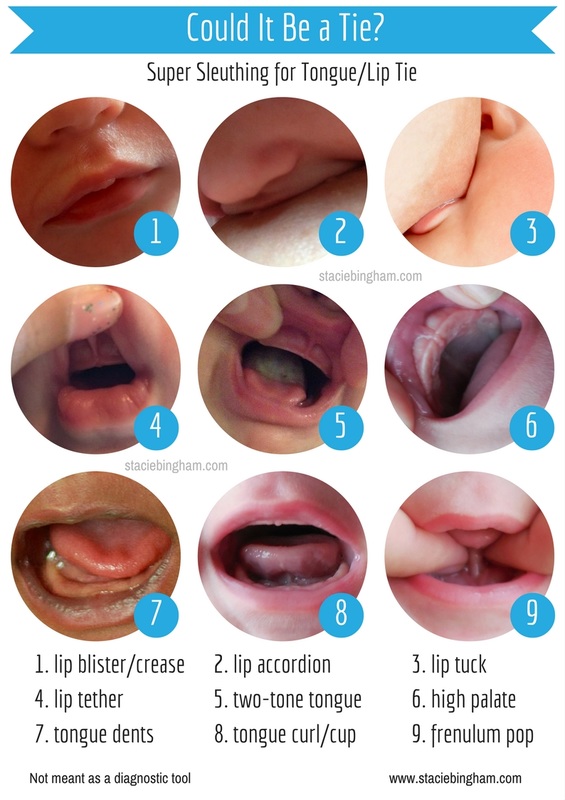 Before we begin, a few notes:
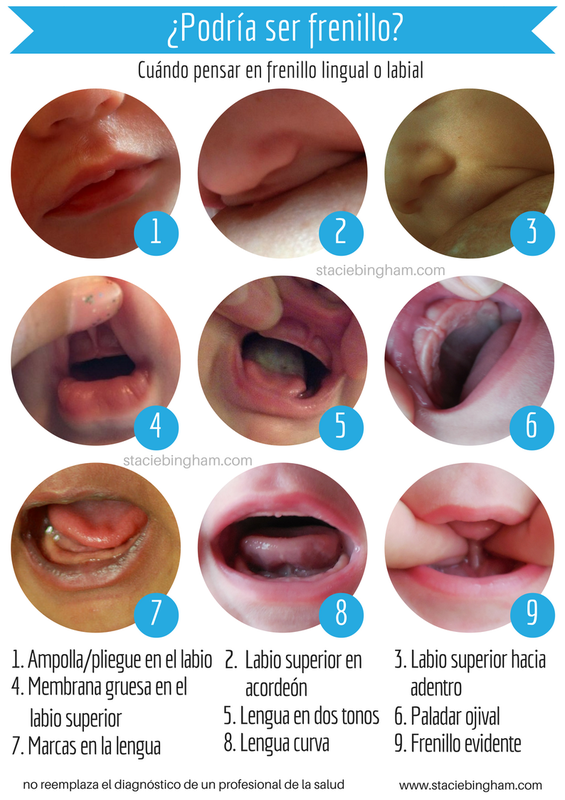
Image 1: Lip blisters are often thought to be a normal part of nursing, but these can actually be a sign of something more. That cute little callus under your baby’s philtrum could show he has to compensate with extra lip-grip versus being able to stay latched to the breast via a well-moving tongue and lip combo. An upper lip that doesn’t easily fan over the breast often folds (image 2) or tucks (image 3) during nursing. If baby has what I term “smeared lipstick mouth” after nursing, this shows the lip didn’t flange as it should. Of course this can be positional, as well; if this frequently occurs, even with increased attempts to improve baby’s latch, it can be something to super sleuth. Image 2: Accordion fan of a tight lip – see that horizontal line under the nose? Instead of opening to the breast, the upper lip folds. The crease will show as a red line once baby unlatches, as in image 1. Image 3: Another compensation for a tight upper lip is that it tucks inward. Some moms can manually turn out the lip by sweeping with a finger; other moms report the lip seems to turn into a tight band of tissue that is difficult to manipulate – it depends on the flexibility of each baby’s frenulum and lip. Image 4: An easy way to get an idea of potential for tongue tie is to flip the upper lip and see how the frenulum attaches to the gums. This is less invasive than digitally checking your baby’s tongue. Many professionals agree, 90% of the time there is an upper lip tie, there is likely a posterior tongue tie. This can be a key in deciding how to proceed. Figure 5: “Two-tone tongue” is a phrase Cathy Watson Genna shared with me when I mentioned something I noticed on my own baby. It is often mistaken for thrush, but often there is a line across the tongue, unlike thrush which can come in patches and doesn’t seem picky about where it develops. If the tongue has impairment in function, it doesn’t get the normal help shedding cells (think about a tongue scraper), and the white color reflects that. Figure 6: Another low-hanging fruit feature is how a baby’s palate looks. When a baby cries, yawns, or is just hanging around, you can often take a peek to see his palate. Ideally, the palate is a horseshoe-shaped, wide surface, because proper swallowing and tongue movements shaped it before birth. Babies with restrictions often have vaulted palates – arch, bubble, channel, or otherwise, due to their inability to make these ideal movements. Figure 7: I don’t know if there is a technical term for this, but many moms report their babies have “tongue dents.” These dents can occur as the tongue is being pulled by the underlying restrictions. Figure 8: When crying, a baby’s tongue may curl or cup up. Again the force of the restriction is controlling the range of the tongue’s motion. Figure 9: If you feel brave enough, and baby complies, you can try to feel for the frenulum yourself. Your baby may be upset by this, but as his parent, your fingers will be the most comforting to him – so if you are really wondering what’s going on, get in there and see for yourself. Place baby in your lap with his feet at your knees and come in from above his face. Gently use your index fingers to try and lift his tongue...and better if you have a partner ready to snap some pictures. I don't claim to use proper terminology. I always welcome feedback and corrections. Find me on Facebook. Much appreciation to Dra. Kelly Marques Oliveira, IBCLC, for translating this into Portuguese. Additional ResourcesTongue Tie Babies Support Group, on Facebook. A peer group with over 20,000 members. A great place to learn local option, ask all your questions, and get support from other families impacted by ties.
Advocates for Tongue Tie Education (ATTE) is a group for parents and professionals. Resources on their website include parent info sheets, educator packets, provider toolkit, and a tie gallery. They also have a Facebook group. Catherine Watson Genna is a treasure trove of information. She is a woman with vast experience and an inquisitive mind, and she offers her knowledge on her website, in books and papers she authors, and in presentations that she travels around the world to share. Dr. Bobby Ghaheri has been exploding with informative, relevant blog posts. He is not only an incredibly experienced ENT who performs revisions, he is also a father and husband whose introduction to the world of ties came through his wife and baby. Dr. Larry Kotlow has a great site that can be a starting point for any parent looking for pictures and presentations. Beverly Morgan is an IBCLC who wrote an exhaustive article full of tons of links, and she shares her own experience of revision as an adult. Dr. Brian Palmer made extensive contributions to the world of breastfeeding and infant oral health. His website addresses ties, palate and jaw development, caries, and more. International Lactation Consultant Association is the best place to find an IBCLC who can assess and evaluate a breastfeeding dyad's situation. International Affiliation of Tongue-Tie Professionals (IATP) is the leading professional organization, and IATP offers resources for parents as well. |
My Life...♥ four young boys and a boy dog (offspring) Categories
All
Archives
July 2020
|
 RSS Feed
Stacie Bingham, LCCE, CD(DONA), CBS(LER)Calm, comfortable Lamaze education & experienced support for pregnancy, birth, & breastfeeding serving Bakersfield, Delano, Hanford, Porterville, Tehachapi, Tulare, Visalia + the World
661.446.4532 stacie.bing@gmail.com |

|


