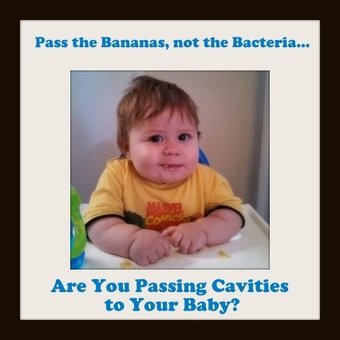
 "I like your food, I don't like your Strep mutans..."
 Did you know a parent or caregiver can pass the bacteria that causes cavities to their babies? As I feed Ezra more of what I am eating, I realize we end up sharing the spoon. If I have untreated caries in my mouth, I can pass the Strep mutans (believed to be the primary bacteria that causes cavities) to Ezra and colonize his mouth and teeth so he could potentially "catch" cavities from me.
We know Strep mutans are not present in babies' mouths at birth. "Research shows that caries can be infectious. When an infant is born, its mouth is basically sterile. It does not
have decay-causing bacteria in its mouth. The decay-causing bacteria is 'acquired' or 'inoculated' at some point in its life. It may be the timing and amount of the inoculation that determines the risk of decay. The infant could be inoculated by Strep mutans in many different ways -i.e.- kissing, using same spoon, etc. Once exposed to Strep mutans, the critical issue then becomes how often the infant is exposed to sugar. Frequency of exposure to sugar is more important than the amount of sugar. A low bacteria count with many sugar exposures can be just as cariogenic as a high bacteria count and less sugar exposure." The late Dr. Brian Palmer was a leading researcher on breastfeeding and oral development and health, and that quote was his, taken from a presentation on his website.
Dr. Palmer also showed us breastmilk is anticariogenic in nature -- meaning breastmilk alone will never cause decay. Now as soon as you add a Goldfish cracker or a slip of dried seaweed -- anything that has carbs in it -- you have the makings for caries. But his research showed teeth soaked in breastmilk did not decay. This is important in light of night-nursing. When babies start to get active and busy, they often shift the majority of their eating from the daytime to the nighttime (we call this reverse-cycling), yet night-nursing is often blamed for infant caries. Wiping the teeth with a clean cloth at night is something some parents do, but admittedly not every parent is awake or aware enough to see this through. Others choose to brush their babies' teeth after dinner and only allow breastmilk or water until morning. Whatever you choose, it is important to be mindful that as soon as your baby's teeth erupt, it is time to start taking care of them.
As parents there are things we can do to help improve our babies' dental health:
There is much joy in feeding that little baby of yours "real food" once they can really go for it. With a little bit of knowledge, and a tiny toothbrush, you have the tools to help protect those teethies while also building lifelong habits of proper dental hygiene.
We know Strep mutans are not present in babies' mouths at birth. "Research shows that caries can be infectious. When an infant is born, its mouth is basically sterile. It does not
have decay-causing bacteria in its mouth. The decay-causing bacteria is 'acquired' or 'inoculated' at some point in its life. It may be the timing and amount of the inoculation that determines the risk of decay. The infant could be inoculated by Strep mutans in many different ways -i.e.- kissing, using same spoon, etc. Once exposed to Strep mutans, the critical issue then becomes how often the infant is exposed to sugar. Frequency of exposure to sugar is more important than the amount of sugar. A low bacteria count with many sugar exposures can be just as cariogenic as a high bacteria count and less sugar exposure." The late Dr. Brian Palmer was a leading researcher on breastfeeding and oral development and health, and that quote was his, taken from a presentation on his website.
Dr. Palmer also showed us breastmilk is anticariogenic in nature -- meaning breastmilk alone will never cause decay. Now as soon as you add a Goldfish cracker or a slip of dried seaweed -- anything that has carbs in it -- you have the makings for caries. But his research showed teeth soaked in breastmilk did not decay. This is important in light of night-nursing. When babies start to get active and busy, they often shift the majority of their eating from the daytime to the nighttime (we call this reverse-cycling), yet night-nursing is often blamed for infant caries. Wiping the teeth with a clean cloth at night is something some parents do, but admittedly not every parent is awake or aware enough to see this through. Others choose to brush their babies' teeth after dinner and only allow breastmilk or water until morning. Whatever you choose, it is important to be mindful that as soon as your baby's teeth erupt, it is time to start taking care of them.
As parents there are things we can do to help improve our babies' dental health:
- Ensure your own mouth is in tip-top shape and role-model good oral hygiene habits. I did last visit the dentist in March, a month before Ezra was born, and my mouth was deemed cavity-free -- I am overdue to go back, but with a baby in my care during common office hours, I keep delaying my visit!
- If you have active caries or current mouth pain, think twice before exchanging slobbery kisses, sharing spoons, or "degerming" the fallen pacifier with a pop into your own mouth before offering it to your baby...same holds true for anyone in close contact with your baby. You can pass those Strep mutans right to your baby and that begins the infection, essentially.
- Practice good eating habits. What the research tells us is, it isn't the amount of sugar we eat, it is the frequency of sugar. My husband shared with pride how he could make his Halloween candy last a year when he was a kid. In my family we were allowed to gobble all of our candy up in the matter of a few days. Everything equal as far as daily brushing routines, who has the increase risk of cavities?
- Know your family history. Did you have an aunt who had an enamel deficiency? Be suspicious for any kind of enamel anomaly or peculiar periodontal paradox plaguing your predecessors (oh my, I had to!).
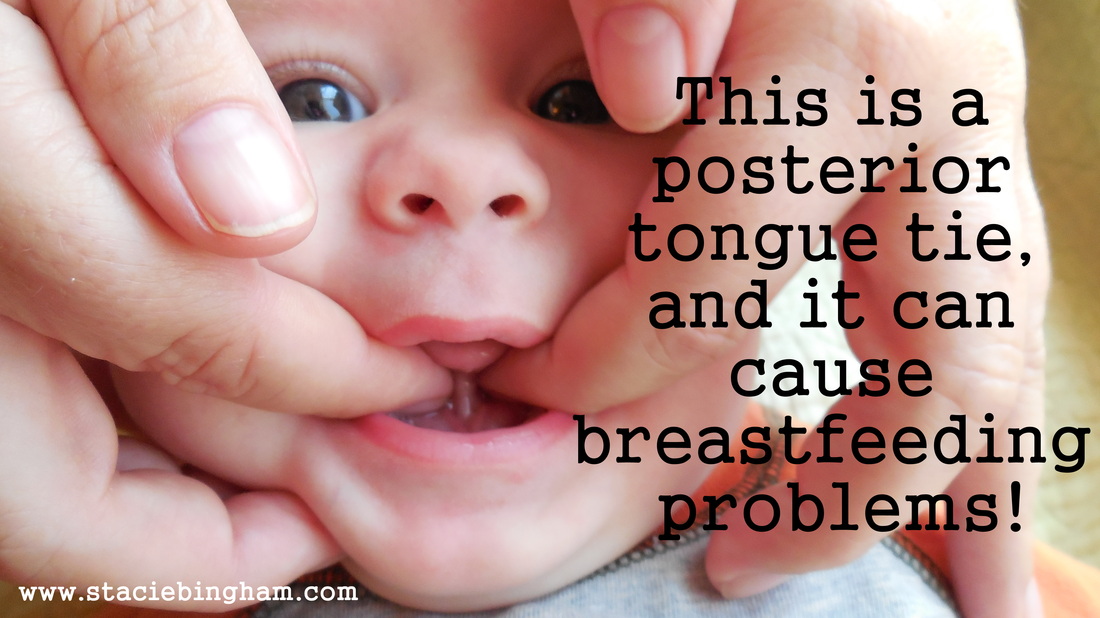
- Along those lines, if you already know someone in your family dealt with tongue or lip ties, be aware there is a possibility your baby may be affected. Some terms you may hear at family gatherings that can hint to tie issues include: "small upper palate" (palate expander needed), "large lower jaw," "high palate;" perhaps someone had to have a frenectomy to remove a space between the upper two front teeth (a diastema). Any of these could allude to a tie issue. If your baby has an upper-lip-tie or a tongue-tie, consider revision. I learned this the hard way 13 years ago with my oldest son. He had his four top teeth capped at 18 months due to restrictions in his mouth -- at the time my husband and I had no idea why that decay occurred. Since then we learned upper-lip-ties can hold bacteria and food in pockets close to the teeth, and a tongue-tie can limit the tongue's ability to sweep out that debris. Often with a tight upper-lip-tie, it is hard to brush the area because of the thickness of the frenulum and the pain it can bring the chid. Dr. Palmer's website also has information on frenulums.
There is much joy in feeding that little baby of yours "real food" once they can really go for it. With a little bit of knowledge, and a tiny toothbrush, you have the tools to help protect those teethies while also building lifelong habits of proper dental hygiene.











 RSS Feed
