
One thing about being a doula is, you learn quickly what positions a mom likes; and you learn just as quickly, what positions are hard for you to maintain. When performing the hip squeeze with your own hands, you exert pressure in an awkward manner (envision your hands on either side of a woman's hips, fingers reaching toward each other over her back, and you pressing inward, with your elbows poking out). But women respond to this over and over and over! By pressing the top of the hips, the base of the pelvis can actually be helped to open wider, and this feels good to the woman, especially if she is experiencing back labor. With my own birth a year ago, my doula was charged with "The hips! The hips! The hips!" as a contraction would build. These tips Marivette shares will definitely save a support person's strength, as well as help the mother with restorative and relaxing ways to cope with labor. Thank you, Marivette!

I first became aware of the rebozo eight years ago when I visited a border town near Weslaco, Texas, called Progresso, Mexico. The women and young girls were carrying babies and toddlers on their backs with a fabric. After showing an interest in that cloth, my mom, who had taken me to visit Mexico, took me to a small store to purchase one. My first ever rebozo was a beautifully woven white rebozo.
Fast forward six years, when I see an advertisement for a rebozo class for doulas and midwives. After reading the information on what the workshop offered, I signed up. That day, was the first day that fell I love with the rebozo for the use in pregnancy, labor, and birth. The Rebozo is a shawl or scarf which is long enough to wrap around a woman's body and has been used for centuries to help women find comfort and support during the birthing process. There are several other uses for the rebozo such a baby wearing, using as a shawl on a cool day or evening, or using it as an accessory to an outfit. These are only a few of its uses; there are many other methods to use the rebozo. In this blog post, you will read about its use in pregnancy, labor, and birth. A rebozo comes in different lengths. For the purposes of pregnancy, labor, and birth, the ideal length is 9 ft long X 2-3 inches wide. The shortest it should be for optimal labor support is 6 ft.. Rebozos come in a variety of textures and colors. My favorite rebozos are the handmade ones from Laos because they are thin, long, and have some beautiful hues.
As a doula, one of my goals is to integrate the partner with the laboring woman. The majority of my clients are husband and wife relationships. The husbands desire to have a very active role in supporting their wife's labor. Where as before, all I had to offer were the use of the hands as a tool, I can now offer the use of the rebozo. Most men like tools. Having a tangible item to use in labor, can help him feel connected to his wife. I have found that the rebozo is a great tool to facilitate the bond between partner and mother. The rebozo can be used to engage the partner in the birth process and is an extension of the labor partner's arms.
There roughly more than 30 different ways that a rebozo can be used for pregnancy, labor, and birth. You will be introduced to five in this post. If you would like to discover other uses for the rebozo, taking a rebozo class or workshop for either pregnant families or professionals would be extremely beneficial. You will gain knowledge and hands on experience in the use of this traditional shawl.
A rule of thumb when using the rebozo, and any other comfort method, is to always ask the laboring woman if she is comfortable with what is being done. If she likes the way it feels, the partner should continue with the comfort measure. IF at anytime the woman feels discomfort the partner should stop what he/she is doing. The partner can readjust the rebozo or discontinue its use altogether. Always measure continuing the use of any comfort method based on how it feels to the laboring woman. Since doulas do not diagnose nor treat their birth clients, the rebozo is meant only for comfort, support, and extension of the arms. The rebozo should never be used as a treatment.
The following are five ways to use the rebozo to give comfort while performing the hip squeeze. The hip squeeze is one of the most desired labor comforts. The partner uses his or her hands to squeeze the hips together to alleviate some of the pelvic pressure from contractions. Hip squeezing can last up to a minute or more during a contraction. Although the partner would never voice this in labor, it can be a tiring job for him or her. If her main support is her husband and he has any wrist injury, he would be unable to perform the hip squeeze with his hands alone. The rebozo can take the place of the hands, thus allowing for longer and stronger hip squeeze support.
As a doula, one of my goals is to integrate the partner with the laboring woman. The majority of my clients are husband and wife relationships. The husbands desire to have a very active role in supporting their wife's labor. Where as before, all I had to offer were the use of the hands as a tool, I can now offer the use of the rebozo. Most men like tools. Having a tangible item to use in labor, can help him feel connected to his wife. I have found that the rebozo is a great tool to facilitate the bond between partner and mother. The rebozo can be used to engage the partner in the birth process and is an extension of the labor partner's arms.
There roughly more than 30 different ways that a rebozo can be used for pregnancy, labor, and birth. You will be introduced to five in this post. If you would like to discover other uses for the rebozo, taking a rebozo class or workshop for either pregnant families or professionals would be extremely beneficial. You will gain knowledge and hands on experience in the use of this traditional shawl.
A rule of thumb when using the rebozo, and any other comfort method, is to always ask the laboring woman if she is comfortable with what is being done. If she likes the way it feels, the partner should continue with the comfort measure. IF at anytime the woman feels discomfort the partner should stop what he/she is doing. The partner can readjust the rebozo or discontinue its use altogether. Always measure continuing the use of any comfort method based on how it feels to the laboring woman. Since doulas do not diagnose nor treat their birth clients, the rebozo is meant only for comfort, support, and extension of the arms. The rebozo should never be used as a treatment.
The following are five ways to use the rebozo to give comfort while performing the hip squeeze. The hip squeeze is one of the most desired labor comforts. The partner uses his or her hands to squeeze the hips together to alleviate some of the pelvic pressure from contractions. Hip squeezing can last up to a minute or more during a contraction. Although the partner would never voice this in labor, it can be a tiring job for him or her. If her main support is her husband and he has any wrist injury, he would be unable to perform the hip squeeze with his hands alone. The rebozo can take the place of the hands, thus allowing for longer and stronger hip squeeze support.
 | 1. Standing hip squeeze The rebozo is wrapped around the woman's hips, then tied as tight as is comfortable for the woman at the front, back, or side in a knot. Only continue if the woman likes the way it feels. |
| 2. Birth ball The birth ball can be a great tool to assist in opening the pelvic inlet. The laboring woman can still have the hip squeeze done while on the ball. Have the mother stand in front of the ball. Wrap the rebozo around her hips and lower back. Support the mother as she sits on the ball. The rebozo can be crossed around the front of the mom and squeezed as tight or as loose as if comfortable for the mom. | 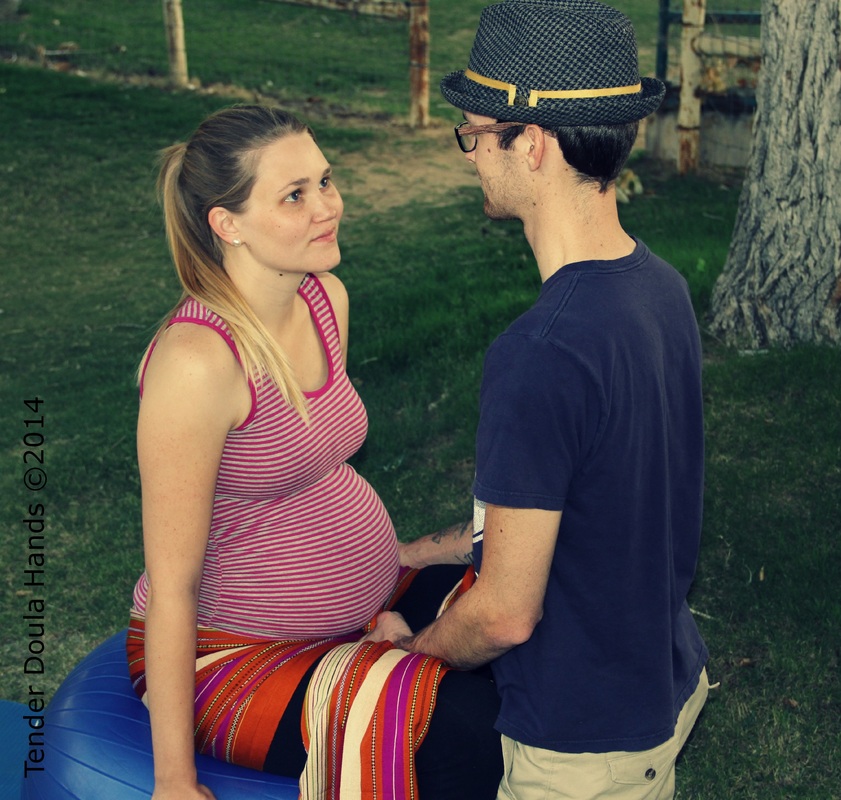 |
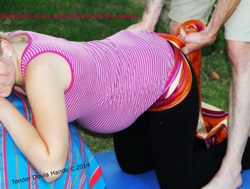
3. Hands and knees
The hands and knees position is great especially if the laboring woman is having back labor. This position relieves some of the pressure from her back. If she isn't having back labor, it could still help take some of the baby's weight off her back. Help mom get on hands and knees. Wrap the center of the rebozo around the woman's hips paying attention to that it is not on her abdomen. For the hip squeeze, we want the rebozo around her hips. The partner holds the open part close to the woman's buttocks, and tightens the hips. A knot can then be made in the rebozo to assist with the squeezing of the hips. Once the knot is in place, the partner can use one free hand to put pressure on the sacrum. Continue as long as mom desires.
The hands and knees position is great especially if the laboring woman is having back labor. This position relieves some of the pressure from her back. If she isn't having back labor, it could still help take some of the baby's weight off her back. Help mom get on hands and knees. Wrap the center of the rebozo around the woman's hips paying attention to that it is not on her abdomen. For the hip squeeze, we want the rebozo around her hips. The partner holds the open part close to the woman's buttocks, and tightens the hips. A knot can then be made in the rebozo to assist with the squeezing of the hips. Once the knot is in place, the partner can use one free hand to put pressure on the sacrum. Continue as long as mom desires.
| 4. Double partner hip squeeze This comfort measure can be used by two people, ie a hired birth doula, or second labor support person like a sister, mother, or friend. With the mom standing, wrap the rebozo around the woman's hips. The two partners stand beside the woman, and hold the end of the rebozo as it cris-crosses in front of her. The patterns then pull on the rebozo as tight as is comfortable for the woman. |  |
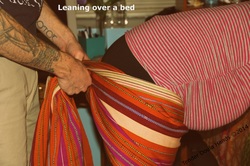
5. Leaning over the bed
This position can be done similar to the above mentioned hands and knees. If she is in a hospital, the bed can be raised to a more comfortable level for the woman's height. She can then lean on the bed and hug a pillow or two for comfort and to support her upper torso. The center of the rebozo is wrapped around the woman's hips making sure not to wrap on the belly while she is leaning on the bed. The partner holds the opened side of the rebozo (fringed side) and tightens the rebozo around her hips. Make a knot at the end close to her buttocks as tight as she likes. The partner will have a free hand to add some pressure on the sacrum.
The use of the rebozo can free a partner's hand to give him or her the ability to use an additional comfort measure such as massage and a gentle anchoring hand on the shoulder. It can assist in longer durations of comfort measures to the laboring woman because the partner is not too tired from using his or her hands. This is beneficial to the laboring woman because she will feel fully supported by her labor team. In all, the rebozo is an amazing tool which can enhance the labor and birth experience.
This position can be done similar to the above mentioned hands and knees. If she is in a hospital, the bed can be raised to a more comfortable level for the woman's height. She can then lean on the bed and hug a pillow or two for comfort and to support her upper torso. The center of the rebozo is wrapped around the woman's hips making sure not to wrap on the belly while she is leaning on the bed. The partner holds the opened side of the rebozo (fringed side) and tightens the rebozo around her hips. Make a knot at the end close to her buttocks as tight as she likes. The partner will have a free hand to add some pressure on the sacrum.
The use of the rebozo can free a partner's hand to give him or her the ability to use an additional comfort measure such as massage and a gentle anchoring hand on the shoulder. It can assist in longer durations of comfort measures to the laboring woman because the partner is not too tired from using his or her hands. This is beneficial to the laboring woman because she will feel fully supported by her labor team. In all, the rebozo is an amazing tool which can enhance the labor and birth experience.

Marivette Torres is the founder/owner of Tender Doula Hands, a rebozo trained instructor and distributor. She is a CBI certified birth doula with 16 years experience serving the Bakersfield, California area. She has eight children ranging in ages from 24 to 6 years old. Her first child was born via surgery at a community hospital due to breech presentation. Her subsequent seven children were all VBAC births, two of which were born at a hospital birth center and five were born at home attended by a lay (unlicensed) midwife. She breastfed all her children with her last child self-weaned at six years old this January. In her birth doula practice, she utilizes some of her own personal experiences and many years of labor support experience with well over 175 clients. She is currently teaching rebozo classes to pregnant women and their partners and to birth professionals which includes midwives, doulas, nurses, doctors, and anyone involved in the birth community. You may visit her website and Facebook page. She also has a page dedicated to specific rebozo class information.
Did you know? For two years in a row, I have celebrated International Doula Month (May) by featuring guest posts by and about doulas? This is Day 28 from 2014, and it is constantly being re-pinned on Pinterest. I am always looking for stories to feature -- so if you are a doula, or had an experience with a doula, contact me to reserve your guest spot! You can write something just for this occasion, or share something you have previously written.







 RSS Feed
