Stacie Bingham - Birth Education, Doula Services, & Breastfeeding Support in Bakersfield & Visalia
661-446-4532
  • home
  • learn
  • birth
  • feed
  • meet stacie
  • kind words
  • resources
  • blog
  • contact
  • for clients

Day 20: Adventures in Doula-ing

5/20/2015

0 Comments

 
Picture
Every birth is its own adventure -- but this one really had my heart racing! From giving birth in a foreign country, to asking strangers for a ride to the hospital -- even the humorous spirit the dad brings to the whole thing -- this birth adventure is inspiring and fun to read. Thanks to Amanda and Charlotte for sharing this with us. 

Sariah knocked on my door at 12:10 am and said “It’s baby time!!” Her face was so hyped up. I was immediately thankful that I was feeling better. “Ok,” I said, “I’ll be right up.”

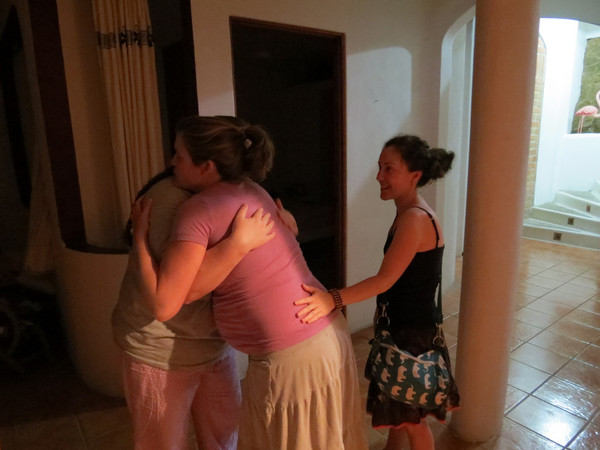
I went into the bathroom and got my ziplock bag of a mini-version of my doula kit. I had good feelings all along that it was going to be a fast birth so I didn’t feel like I had to bring very much. I went upstairs to their apartment. Charlotte greeted me with a big grin. She said “I’m having lots of contractions and I can’t talk through them.” We were all excited.
Picture
She phoned the doctor, as she was standing on the second step. She began having a contraction so she handed the phone to me. I heard a beep and I wasn’t sure if it was an answering machine so I just started talking.

“Hi, this is Amanda, Charlotte's doula. Charlotte is in labour and we are going to head to the hospital.” Then I heard a very groggy voice say “Ok, Charlotte…. right…. ok how long until you are at the hospital?” 
“45 minutes,” I said.
“Ok, I’ll meet you there.”

We phoned Oscar, our taxi driver who was going to be on call for her birth. Charlotte had a few more contractions and then Oscar knocked on the door. Eric grabbed the bags and we were headed upstairs.

As we were gathering our stuff, Cora woke up. She hadn’t woken up in the night for over a year, Eric told me later. She woke up, sat up in bed and said “Baby sister is moving.” Charlotte went over to her and said “Yes, baby sister is coming.” Cora said, “Um, yes. I’d like some milk.” Sariah and Charlotte laughed. “Yes, Cora. You can have some milk.”

We went upstairs and got in the cab. Charlotte was on her hands and knees in the back seat of this huge van that Oscar brought. We all got in and Oscar tried his first attempt at the very steep driveway. The tires squealed in protest. He reversed and tried again.

Oscar’s friend who was with him hopped out. Then Eric got out too and they were trying to figure out how to get the van out of the steep driveway. Charlotte was getting anxious as she didn’t want the van to roll back and squish Eric. She was yelling at him a bit from inside the van. Then they reversed and tried going up the other side of the driveway. (The driveway was a circle.) No luck on the other side either and then Charlotte said, “Oh, my water just broke!”

I yelled at Eric that Charlotte’s water broke. It was clear the van was not getting out and the bumping and jostling was really hard on Charlotte as she barely had any time between contractions.

Finally she turned and yelled at Eric out the window, “We need to get out of here!” He said “Ok babes, I got this! I will get us out of here!”

By this time the taxi drivers were talking to this other woman at the top of the driveway. Eric walked up to her and asked “Can we get a ride to Puerto Vallarta please! My wife is in labour and her water just broke.”

The lady said “Of course. Jump in!”

The lady, who introduced herself as Georgina, and her English husband Danny owned the smallest car in existence. And in the backseat was a carseat. Georgina wedged herself into the carseat. Charlotte was in the front seat on hands and knees. I was in the middle, leaning forward, rubbing Charlotte’s shoulders and whispering encouragement into her ear. Eric was beside me in the backseat.

Danny was an excellent driver. Between he and Georgina, they knew every bump and pothole along the way. He was careful and he was very fast. Charlotte worked on keeping her moaning low pitched to allow her cervix to Open Open Open. I would count on her ear when the contractions came, to give her something to focus on. We would come up to a red light and Georgina would look and say “Ok, Danny. Just skip in. We have to keep moving!”

Outside of Bucerius, there was a police car going the same direction as us, we pulled up beside it and Georgina, sitting in the child’s car seat, yelled out the window to them, asking for a police escort.
Picture
Picture
They pulled ahead of us, lights and sirens going, and we went very very fast behind the cruiser. He pulled off as we got to Nuevo Vallarta, and waved us onward. Charlotte was doing so well through all this stress. The contractions were strong and very frequent. She concentrated on her noises and said “Open open open.” Her ability to remain as calm as she did through all this uncertainty and near-disaster impressed me to no end.

The epidural was in place and Dra Laura said “I have to move the baby’s head just slightly. I am going to stick my hand up and when I tell you to, I want you to push just a little and I can tip the baby’s head.”
Picture
Dra Laura did just that and Charlotte looked at me with wide eyes and said “I can feel the baby coming down the birth canal.”

They decided it was time to move Charlotte to the delivery room. They told Eric and I to go put our stuff in her postpartum room and then come down and get in our scrubs. He and I got into the elevator with all our stuff and were just told a room number. The doors shut as we saw Charlotte wheeled down the hall and Eric looks at me and says “And this is when we steal your baby!” And I laughed. But we both felt a bit uneasy.

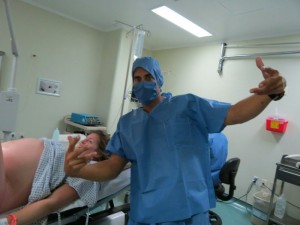
We dumped the bags and headed back down. The hospital was entirely empty so we weren’t sure where to go. We saw someone and asked. They gave us scrubs and we were changing and trying to figure out a one-size-fits-a-mammoth scrubs. Eric’s head bandana looked like a nun’s hat until he tied it. Then he tilted it to the side, real gangsta’ style.
Picture
We got in the delivery room, as Charlotte’s baby was starting to crown. She said “The baby will be here any minute!”

Within 10 minutes, the baby’s head was clearly going to come out. In between contractions, Eric started telling me a pirate joke, which I honestly can’t remember a word of. Then suddenly, out came the baby! They cut Lyra’s umbilical cord and lay her on Charlotte’s belly. Charlotte cried and said “Hello, welcome baby!” Eric too was making joyful exclamations of being a dad again. 

They took Lyra to the warmer, and checked her out. The pediatrician suctioned out her nose and she put her hands up to fight him. She was immediately alert and looking around. Charlotte quickly delivered the placenta so that no one but the doctor even noticed.

The staff put Lyra in an incubator and took her to the nursery with Eric following closely behind. He was clear and confident in his role of dad. I mean, he’s done this all before!
Picture
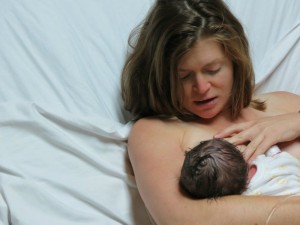
Charlotte and I stayed in a corner of a hall for more than an hour while we waited for the effects of the epidural to wear off a little. Then after a few times asking the nurse, they moved her upstairs to her room. Soon they gave her baby Lyra and Lyra latched on immediately.

Mom and baby safe and happy. After such an adventurous and fast labour, they were home from hospital that very afternoon.

It was such a privilege to be a part of a whirlwind Mexican birth experience. Charlotte, I am extremely proud of you at what you accomplished. Eric, you were a fantastic and assertive father in exactly the role you needed to play. You together make a great team and I am nothing but grateful to be included in such a momentous day.

Picture
Amanda Seguin CD(DONA) LCCE, gave birth to her baby December 2010. She had doula support and loved what that brought to the birth. This experience led Amanda to pursue becoming a doula herself in 2011 -- Amanda has completely enjoyed the journey, also becoming a certified childbirth educator. Every birth is unique, and Amanda learns something every time. She has a special passion for helping families who face parenting a baby with compromised health, as she has navigated this potentially confusing and unfamiliar medical world when her daughter was born with a congenital heart defect, requiring multiple surgeries. Amanda lives on the West Coast of Canada, and serves families in the Victoria/Sidney/Gulf Islands area. To learn more about her, visit her website.
0 Comments

Day 19: Why I had a Midwife AND a Doula

5/19/2015

0 Comments

 
Picture
Monica shares her thoughts about the differences she noticed between her midwife-supported birth and her midwife-and-doula-supported birth. There is good information about roles here as well -- helpful when trying to explain to family and friends what your midwife will do, and what your doula will do. 

I had a doula at my second homebirth. A lot of people asked me why. Here is what I have come up with.

1-First, a doula is not the same as a midwife. Your midwife takes care of all your medical needs and your baby’s medical needs. Your doula isn’t a medical professional. She gives understanding and support for you while you are in labor. She also gives support to your husband.

2-After my first birth at home with a CNM, everything was great. My midwife came with all her supplies. She was perfect at helping me get the birth I dreamed of in the medical way. But I did feel I needed more of the kind of support a doula could give, meaning, just focusing on me and my emotions and physically having labor and my baby. My midwife was taking care of me and my baby, but it was hard to get the support I needed to cope with everything I was feeling.

3-My doula came before my midwife. This was great for me and my husband. He was very worried the first time around. He kind of hung around not sure what to do. I know he was worried and even with good classes he didn’t know what to expect. When our doula came it helped my husband see that laboring was going smoothly. He was also able to relax and know we were both being watched out for.

4-My midwife wanted me to tell her when things were happening with labor. But that didn’t mean she was ready to come and stay with me yet. My doula was able to come be with us earlier in labor and just hang out. She went for a walk with me, and she made me and my husband some sandwiches. She suggested I lay down for a while to rest. She helped remind me of how to take care of myself.

5-My doula and my midwife made a great team. They had worked together at births before. My midwife said I might want to look into a doula the first time but I felt secure with my midwife and her help. Even if the second birth was just like the first with only my midwife, it would have been good. I wanted to try a doula the next time. And I am glad we did. With a doula, I felt like I was being catered to more and taken care of more. It was the difference between a homemade chocolate chip cookie fresh from the oven, or a homemade chocolate chip cookie from the oven with ice cold milk. I am glad I had the full experience. Now I know the best combination for me is a doula and a midwife. 

Monica is a Respiratory Therapist who currently stays home with her two girls. She often worked on the OB floor of a major hospital in Florida. She became friends with, and developed a deep respect for the midwives there. When she was pregnant with her first baby, the midwife she wanted to see was relocating across the state, but this midwife suggested a friend who offered homebirth, and Monica was hooked. She, her husband, and their girls love hiking, camping, and of course, the beach. 
0 Comments

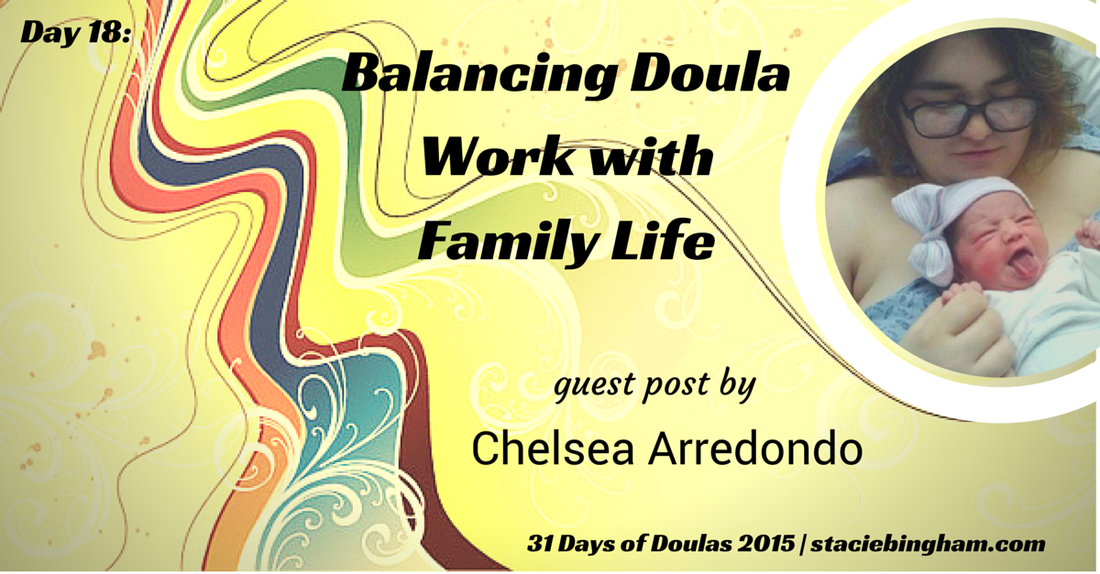
Day 18: Balancing Doula Work with Family Life

5/18/2015

0 Comments

 
Picture
Although Chelsea is in my area, Bakersfield, I "met" her in an online doula group. I love connecting doulas together, so immediately we began talking, and soon after we met. I knew she was busy last week, with some surprise early babies. I asked her to share what she learned as far as meeting the need of her clients and her families -- thus this post was born!

I believe I’m the youngest doula in my area at just 20. I have two young babies of my own and I’m learning to balance work life with mommy life, along with being married and having my own home. This last week has been crazy with two births back to back -- six long days of trying to get my footing and figuring things out. I learned five key facts this week that will help me get through many more times just like this one!

1.      Have stable childcare! I’m serious. I wasn't expecting two clients to have babies so early so I still hadn't set up childcare. I was rushing around like a mad woman trying to find people to keep my two while I ran off at odd hours to births. My dad and my best friend ended up taking the blunt force of my lack of planning. Random calls of “Can I drop them off right now?” and having to answer the question of, for how long with, “ I HAVE NO IDEA." So this is definitely of primary importance as a doula and a mom of 2.

2.      Remember you need to eat too! We are constantly encouraging moms and dads during births to eat and stay hydrated. Well I forgot that I needed to, too. I got home from day one of births this past week and realized I had eaten a pack of mini donuts and a Dr. Pepper -- and that was it all day! I suggest having small snacks in your bag like granola bars and a bottle of water that can be refilled.  How can you care for mom and dad if you, yourself, have no energy whatsoever? 

3.      This one is super difficult. Balancing sleep/work/ motherhood. I was coming home from nights at the hospital at 3 and 4 am.  I would come home to my very lived-in house and shudder, knowing that I needed to do housework. I would go and lay down in my bed and fall asleep doing none of it. My husband, I’m one of those super lucky women by the way, would get up with the kids in the morning allowing me a few extra hours in the bed. I would then get up, still exhausted, to spend time with my kids, not knowing when I would need to rush off again. You have to find a balance between them all. I know its hard, but it's a necessity!
Picture
4.      I had to learn when enough was enough. I sat in a client's room until 3am while she slept, and I watched her every movement, waiting to get up and walk her through the next contraction. When she was asleep and her meds were working, I was still on that super uncomfortable doctor's stool. I waited and waited until finally, I was okay to head home.  I was burning myself out much too quickly. I was tired and hungry and frustrated that I couldn't have done more.  You have to learn that it's okay to take care of yourself, too.

5.      This one is the closest to home. I was sitting up at the hospital at random intervals for 6 days. I missed my babies. I missed my husband. I missed my puppy and sharing my bed with them all. I got close to crying several times from missing them. But I had to sit back and realize doing what I was doing was beneficial for us as a family. Jumping head first into my work while the timing is right, giving myself the chance to bring in more income helps my family! We plan to have more children, and I know doula work will come and go according to our family life. Right now I can show my babies that moms can do amazing things. Know that if you are doing what's best for you and yours, that not only brings security to your family, but also it offers support to the expecting family -- that helped me when looking at all the hours gone by.

This past week has been crazy for this brand new doula! Two births back to back. Preemie ones at that. I’m exhausted. I’m happy. I’m PROUD. I’m helping change our birth community one birth at a time, and that feels amazing.

Picture
Chelsea attended her first birth in February of 2015. She was led to doula work when she realized how little women understood about their bodies and their choices around pregnancy and birth. Motivated to help that change, she is training formally through Birth Arts International, with the ultimate goal of becoming a midwife. Chelsea and her husband have two little ones, and a brand new puppy. You can learn more about her by visiting her Facebook page. 

0 Comments

Day 17: The Doula who Sisters-the-Mother

5/17/2015

0 Comments

 
Picture
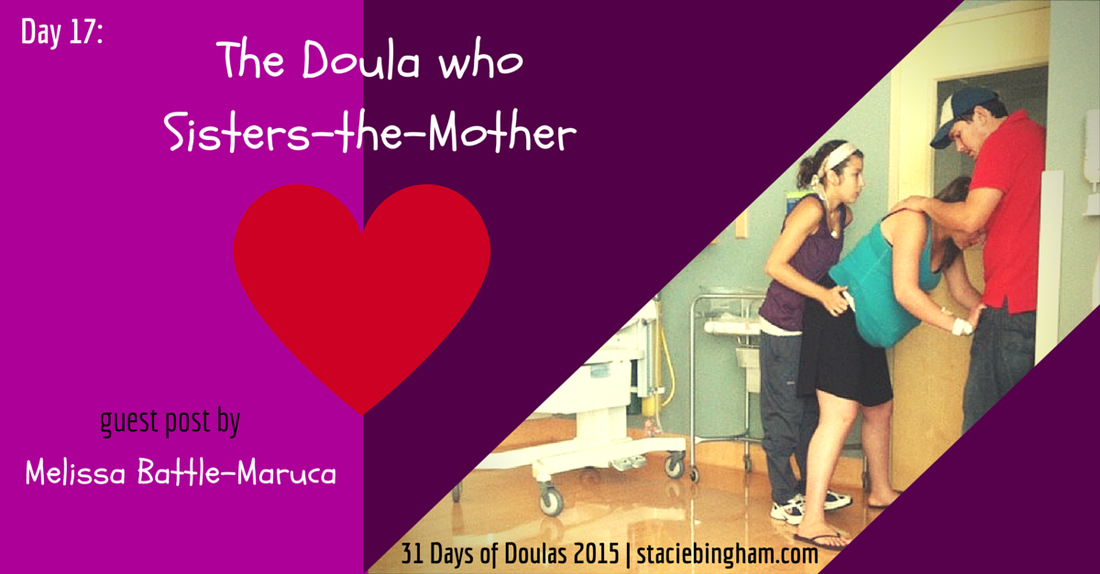
Melissa is another fabulous doula in the Modesto Doula Group. She brings up some great points about doula work, including potential awkwardness when the mom you are supporting is older than you are, and the many reasons why doulas burn out. 

I am currently 24. I started "Doula-ing" when I was 21, right after the birth of my first child. I had always been fascinated with the biological mysteries that surrounded birth. It was always my most anticipated subject in science. I was a birth junky from the start and I didn’t even know it. I first started out like most young doulas, volunteering free services just for a chance at some experience. I attended the birth of a friend; other than that though, business was fairly dry for me in the beginning. It was slightly discouraging as I was so eager, but at the same time I had a 6 week premature infant to care for so I wasn't exactly striving to be extremely busy with births. 

I got the opportunity about 6 months after my first DONA training and birth to come and sit in the Bradley class I had taken while pregnant, by my old teacher. It was potential for a birth and I felt fairly confident. I was hired by two couples in the class, both women about 6-7 years older than myself. I felt the twinge of hesitation from the both of them when I told them my age. I wasn't surprised. Standing at 5'2 and only about 114 lbs soaking wet, I looked more like 16. The teacher assured them of my skill set, and I was officially on call. 

When I was called into the first birth I was slightly nervous, not knowing if I was going to have to work harder to gain trust from someone older than me. I was taught to "Mother the Mother." How do you "mother" someone older than you without sounding slightly patronizing? All in all it worked out fantastically and we found our footing together. When I really think back through the births I have been hired for, I have noticed that almost all the women I have served were older by quite a few years, and it makes me wonder if the younger doula's out there question age gap between themselves and their clients.  

I did a very informal, and simple, one-question survey (thank you, Facebook): "How old were you when you started Doula-ing"? Out of 100 answers that I got, I averaged it out to the age of 27. The number seemed fairly accurate to me since by this age most people have had a childbirth experience (whether personal or a family member) that has led them to the path of birth work. But when I started to dig deeper, I started realizing how high the burnout rate of birth support professionals really is. 

Most women who train to be a doula only average 2 years in the field. The worst part about this is that I am not the least bit surprised. The idea of birth work is largely romanticized in my opinion. It's easy to think of being with birthing families and babies during one of the most important and transformative times of their lives, and look right over the not-so-nice things, like the long hours -- and I'm not talking 2-hours overtime type hours. I'm talking about the births that last 22-57 hours from start to finish. 

The exhaustion after long births is felt on a cellular level. Emotionally you are too tired to care about anything but the next step you are taking, and physically, well let's just put it this way, along with your arms being sore from the double hip squeeze that you did for 17 hours, and your legs being sore from standing and supporting another human for that long, even your teeth and your hair hurt. But it's even more than that, it's the expectations of an ideal birth that fall just a bit short for whatever reason. It's the looks from resentful hospital staff. It's watching a family's entire world fall apart in front of them. This is what I think causes a large number of doula burn-out -- we are not prepared to handle the true exhaustion of body and spirit.  I don't want to take away that magic of birth work, because I wouldn't trade this job for anything, but it's anything but easy. And when you start out in this field without anyone to help guide you, it can be impossible to continue going without feeling disheartened along the way.  

I have been extremely fortunate -- I was taken in by a fantastically wonderful circle of experienced doulas and together we created a (totally kick-ass) Doula Group. Being the youngest in the group, it’s a bit different for me sometimes, in the sense that my birth approach is different. I learned after those first initial births that instead of "Mothering the Mother" I "Sister the Mother." I try hard to get on a sister/friend level -- someone that is along for the ride with them no matter how many bumps there are in the road. More peer, less authority. I have been told on more than one occasion that I am an assuring presence in birth because, "seeing someone so young and knowing that you have done and accomplished what I am trying to accomplish is comforting." I have gotten out of the nervous mindset of working with a clientele that is older than I, because it doesn't help anything.I go in confident in not only myself, but also the laboring mama and the process of birth, and this is what helps.  

I have come to realize that there are definitely some up-sides to being on the young end of the doula age-spectrum, at least for me. Before getting pregnant with baby number two, I was actively training for my black belt in Kung Fu. To say that I have the physical stamina for this job is an understatement! Not only that, but I love the physical demand of birth work. If I don't feel sore after a birth I wonder if I didn't do enough.  

Another thing that was brought to my attention by my favorite midwife in conversation about this particular topic of age was: "The earlier you start, the more years of service we can get out of you, and the longer period of time you can commit to the long-term vision of radically changing our maternity care system. There is no end to the benefit of young women going to births. Of course all women at whatever age they start get my vote and I'm excited about it, but I look at young women like, great! So we can get close to 50 years out of you!" And its true! The younger doulas start, the more of a difference they can make. The more experience they can gain. The more knowledge they can spread.  

The fact is that no matter what your age, if you are a dedicated doula, you will find a way to practice that works for you and your mamas. You're always the right age to help provide evidence-based care and support.

Picture
Melissa is Birth Doula certified through Still Birth Day. She is one of the doulas in the Modesto Doula Group. She is an experienced Bradley Childbirth practitioner and assistant instructor. Melissa has a background in Child Development, Education and Psychology, and an interest in special-needs and high-needs children. Melissa brings to her clients her personal experience and expertise with premature labor and birth, the challenges of parenting in the NICU, and breastfeeding a premature baby. She has excellent skills in communication and listening, massage, visualization and meditation practices to help during pregnancy, birth, and the postpartum period.

0 Comments

Day 16: Top 10 Takeaways from the Birthkeeper Summit 2015

5/16/2015

0 Comments

 
Picture
I first met Teri at a doula gathering where I shared my experience creating a group doula practice. The energy in that room was invigorating, and I wasn't surprised to later learn these doulas had created their own successful group. Teri and I had a thoughtful exchange about how this summit left her feeling, and I believe she brings excellent balance to these trickier topics that factor into birth work.

Last month, I had to the good fortune to live close enough to Berkeley, CA to know about and attend the first annual Birthkeeper Summit.  To be honest, I wasn't sure why I was going other than to be in the same room as Michel Odent, Robin Lin, Nan Koehler, Loretta Ross and a number of other birth visionaries and human right activists, and to hear their wisdom firsthand.  The academic in me has a hard time resisting conferences, and so it was obvious I would go.  The doula in me, whose goal it is to help moms have whatever birth they feel is the right birth for them -- a goal that never comes attached to other agendas -- was a little hesitant.  There were going to be some strong personalities and a whole lot of agenda-driven discussion.  My stress level rose just thinking about it.  Yet I knew if I didn't go, I'd be missing something significant.  I braced myself for the potential of being overwhelmed by birth activist energy, shelled out my $100 for the entry fee, and took four days off-call from my very busy practice.  (Many thanks to my doula team for making that latter event possible.)  

The Summit did not disappoint in regard to being overwhelming and was more than a little transformative for me personally.  It brought together a diverse group of birth workers who advocate for evidenced-based birth practices and access to safe and supportive care, and others who actively pursue reproductive justice and familial rights.  It offered several panel discussions with experts in their respective fields, an eclectic assortment of more than 40 classes and lectures on topics ranging from social activism to spiritual healing, several movies and rare documentaries, and many opportunities to network and socialize.  In short, the summit participant had ample opportunities to get cerebral, ethereal, and/or real.  I both entered and came away with the sense that there was perhaps a little too much going on and not enough time to experience more than a quarter of it.  In addition to the obstacle of not enough time, the Summit encountered the challenges of meeting the needs of such a diverse group, not all of whom came prepared to engage in constructive ways with one another.  I had expected a symbiosis, that all of us would be coming together from our different backgrounds to find each other's strengths and work together.  Instead, there were awkward and uncomfortable moments when I felt we were called out and separated by our identities, affinities, age, experience, and even the color of our skin.  Kathi Valeii at the Birth Anarchy wrote about that part of the conference already, so I can leave it there, sufficing to say in retrospect that it forced me to think a little harder about my own identity, and, difficult as it is, more self-understanding is always a good thing.

On that note, let me begin my top 10 takeaways from the Birthkeeper Summit 2015:

1. As birthworkers we must acknowledge our own biases and limitations.  We must also acknowledge that no one doula can be the right doula for every client.  If a woman of color/queer identifying/transgendered/teen parent needs a doula of color/LGBTQ/teen to feel understood and supported, that is her prerogative.  If you're a middle-class, white doula, it's not personal, so don't take it personally.  Side note: If you identify in one of those former categories, the birthworker community and birthing families need more of you.

2. We all have birth stories which are valid and worthy of being heard.  None is more or less significant than the other.  Each individual story has something from which we can all learn.

3. One can and should be open to hearing and trying to understand the experiences of others, but this willingness is a lost opportunity when those with wisdom refuse to share it.  If all you know is your own experience, your universe will remain hopelessly small.  Engage and seek knowledge.  Side note: Be mindful of respectful discourse.  Don't expect that it's anyone's obligation to teach you.  

4. Be kind to the students.  We are all children of this earth and as such we all ask dumb questions sometimes.  Side note: The teacher and parent in me feels obligated to say here that there are no dumb questions.

5. Loretta Ross said some brilliant words that resonated with me: First, don't be allies, be a "co-conspirators."  Second, invite people into dialog, especially those with whom you don't agree.  Call each other "in," don't call each other out.

6. Every community of women deserves a red tent.  Apologies for the cultural appropriation, but it's a useful adaption.  In this case, women (all people actually) deserve a place to come together in safe harmony to share their stories and repair their spirits.  In the birth community, we sometimes call that space a red tent.  The refuge of the red tent at the Summit was lovely and restorative.  Many thanks to whomever put that together.

7. Paraphrasing Michel Odent speaking on the research done on initial stress responses and their effects on newborns who experience immediate separation from mother at birth: "It's taken 100 years for the medical community to figure out that a newborn needs its mother."  We've still a ways to go on reclaiming that "golden hour" of bonding time for healthy newborns.  Side note: He's also got intriguing data collection on what happens to babies who aren't given a trial of labor.  If you don't know who Dr. Odent is, look him up.

8. As a birthworker, who immersed myself in the culture of evidence-based care for an extended weekend, coming back to the real world was painfully hard.  My first week back involved supporting a mom who was fighting against a 39-week routine induction and whose care provider had no interest in hearing about her evidence-based arguments.  On the plus side, ACOG's letter for the BKS organizers announced that they were considering "collaborative team-based care that includes the mother as a member of the team and a key decision maker."  One can hope that in my life time this becomes the new standard practice. 

9. Listening to Katsi Cook and Isa Gucciardi, I became envious of cultures that retain a process of initiation.  Modern American culture has forgotten how to initiate people into parenthood (and adulthood for that matter).  A baby shower, grocery store encounters with strangers, and well-meaning but often fear-filled birth stories hardly fulfill that role.  I'm not sure the appropriation of blessingways do the job better, but they are a step in that direction.  Side note: Take a minute to celebrate your mother, because chances are good she had to figure that role out all on her own (see above about being kind to students...).

10.  Lastly, to the doulas out there: Take a minute to honor yourselves.  You do hard work, often without a lot of compensation other than the satisfaction of knowing you made a difference to every family you worked with. 

Picture
Teri Nava-Anderson, PhD, CD of Harmony Doula is a birth doula, doula trainer, childbirth instructor, La Leche League leader, mother, and historian. She is passionate about encouraging doulas to advance their skill sets and helping moms advocate for their best care. She is the co-founder and lead mentor at the Modesto Doula Group and a board member at the Mt. Diablo Doula Community. Teri is an advocate for the creation of doula group practices for the health and well-being of both doulas and birthing families and advises and mentors doulas seeking to move from private to group practice.

0 Comments

Day 14: Things I Wish I had Learned...

5/14/2015

1 Comment

 
Picture
Here is another take on a doula's experiences in nursing school. Amanda offers insight into what she has and hasn't learned in her different educational pursuits, and I, for one, was surprised by the results. These are excellent points to keep in mind as we work with families and with nurses. 

Things that I learned in nursing school that I wish I had learned in doula training:

1.       How hospitals work:  Hospitals are complex systems that practically have a life of their own.  Many different professions work together to create the beautifully synchronized dance that is a functioning labor and delivery ward.  The various actors all have their own roles to play and each one is important.  Nurses assess and monitor.  Patient technicians take vitals and help with repositioning and other essential tasks.  Doctors and midwives are responsible for the health and wellness of several mothers and babies at a time.  Anesthesiologists administer epidurals.  Even the housekeeping staff have an important role in keeping contamination risks at bay.  This doesn’t even take into account nurse managers, case workers, social workers, scrub/OR nurses and the hospital administrative staff.  If any part of the system isn’t perfectly coordinated, it can cause problems in many other parts of the unit.  My presence as a doula should not be a hindrance to how the unit operates.  In fact, it should add to the effectiveness of the whole team and knowing what everyone else is responsible for and keeping within my scope will ensure this.

In a large birth center, it is very easy to get lost in the hustle and bustle of so many people and so much activity.  I highly recommend that all doulas take a tour of any birth center that they are not familiar with prior to going there to support a mother in labor.  Ask questions about nurse to patient ratio and how many patient technicians or aids are usually on each shift.  Ask about their intake and triage procedure.  Ask if the labor and delivery unit is separate from the postpartum unit or if the mother will remain in the same room throughout her stay.  Orient yourself to the floor, making sure you find the ice machine, the family lounge, the restrooms, and the vending machines. 

2.       What L&D nurses actually do:  When I began my training as a doula, I had a false sense of what labor and delivery nurses actually did.  I assumed that they would be “hands-on” with the patient often, either by taking vitals or doing vaginal exams or other “medical” things that I only vaguely defined in my head.  In reality, most of their job consists of observing, assessing and documenting with a healthy dash of caring thrown in.  Nurses are the primary eyes and ears in the room for the doctor, midwife, and laboring mother.  She is the first one to notice if something just doesn’t look right and the first one to take steps to mitigate any problems. 

As doulas, our job is to facilitate a good working relationship between the nurse and the laboring woman.  Respect the nurse and the important job that she is doing.  Advocate for the mother’s preferences regarding monitoring and assessments.  Better yet, teach the laboring woman how to advocate for herself.  Make suggestions on how to meet both the need for monitoring and the need for freedom of movement, such as moving the birth ball to right in front of the machine so the wires will reach, using a wireless pack, or using intermittent monitoring instead of continuous.  Ask the nurse if there is anything that you can do to make her job easier.  Above all, remember that very few nurses went to nursing school because they like to chart!  These nurses chose to be in labor and delivery because they care about these women.  These nurses may see you as a threat because you are taking the best part of their job away from them – being the shoulder to lean on and the person who gives reassurance.  Let the nurse share in supporting the mother with you – that is a win-win situation for all parties involved.

3.       The rationale behind “Policy”:  The hospital, the doctors, the nurses, and doulas all have one common goal: the health and safety of all of the women and infants.  The hospital’s policies are usually a source of grief for my clients.  They are viewed as rigid rules that impose on their body’s ability to birth naturally.  I am not going to address any one policy in this section, just the reasoning behind these policies.  The hospital wants to ensure the safety of EVERY woman, not just one specific woman.  They know that for every so many hundred births, something will go wrong.  They address this by instituting policies on everyone to make sure that those few who will have something go wrong don’t get missed until it is too late.

Sometimes these policies are out of date or not applicable to a mother’s personal situation.  If that is the case, the mother can always opt out.  It is easier to do this if the mother knows the policies ahead of time and can talk to her caregiver about it, but it is never impossible.  (I know a woman who didn’t just change doctors, but changed hospitals at 8 cm dilated in active labor to avoid a policy that she didn’t agree with.)  For every procedure that is done in the hospital, the informed consent of the mother is required.  Informed consent mandates that the mother understands the benefits of the procedure, the risks associated with it and how likely they are, any alternatives to the procedure, what happens if it is not done, and any implications of her decision.  A woman always has the last say in what happens to her body!  To best advocate for your clients, make sure that they know how to advocate for themselves by asking the right questions, knowing where to look for unbiased information, and ensuring they have enough information to give informed consent or informed refusal.

Things that I learned in doula training that I wished I had learned in nursing school:

1.       What labor and birth look like without intervention:  This may or may not come as a shock to you, but in the course of my Nursing Care of Women and Children class we did not once see an unmedicated labor.  All of the videos that we watched in class were of women who already had an epidural in place.  At my placement site for the clinical portion of the class, more than 90% of women had epidurals.  The 10% who didn’t, were usually attended by midwives instead of obstetricians who didn’t allow students in the room.  In a four hour lecture on caring for women in labor, we spent 15 minutes on managing labor pain with opioids, 45 minutes on epidurals and the nursing care involved, and less than five on all non-pharmalogical methods combined.  

This seems to me to be a chicken or an egg type of a conundrum.  Do we spend more time on epidurals because that is what most women choose?  That makes sense to the practical side of me.  Of course we need to learn how to care for women with epidurals, and if that is the majority, then shouldn’t we spend the most time on that?  But what if, we as nurses, unconsciously push for more epidurals because that is what we are the most comfortable with?  

Obviously, I can’t speak for anyone’s experience besides my own, but if I had not been a doula prior to nursing school, I would have never seen an intervention free labor.  I am in the camp that believes that birth is not pathological and that we should not intervene unless there is something going wrong, so the idea that there are practicing nurses who have never seen one without intervention seems unusual at best.  Therefore, I would like to see a more comprehensive nursing curriculum that covers non-pharmalogical pain management and an intervention-free labor more in depth, even if it is just a film.

2.       The importance of the psychological state of the mother:  Birth doula training focused on this topic extensively.  Human women are just like all other mammals in that to give birth we need to feel safe and secure.  That just makes evolutionary sense: a woman in labor is vulnerable and so is her infant.  Any increase in stress during early labor can stall progress.  Additionally, fear and anxiety are well known to be associated with tension.  Tense muscles during this time when the mother’s body needs to relax and open up can increase the amount of pain that is felt during labor.  

Birth doulas use this knowledge and spend most of our efforts trying to reduce stress.  We create an atmosphere of peace by dimming lights and playing soft music.  We empower a woman to feel like she is in control, even when her body is listening to more basic instincts.  We are the gatekeepers for mother-in-laws and supporters of partners, so she is free to worry about a few less things.  

Nurses could be a huge ally in this process.  They are gatekeepers of a different kind.  They can cluster tasks to minimize interruptions or space them out if the woman needs a distraction.  They can knock before entering the room and insist that others do so as well.  They can protect the space better than doulas can, by making sure that other hospital staff do not come in to refill supplies or empty the trash.  Nurses also have the importance position of being the intermediate between the hospital and the laboring mother.  Orientation to the room and floor is essential to feeling secure.  It is amazing how much difference knowing where the family lounge, the bathroom, and vending machines can make.  Listing the names of the nurse, the patient technician, and important phone numbers somewhere in the room can give the mother a sense of belonging and welcome.

3.       Physical support of a woman in labor:  The birth doula workshop is truly an amazing experience.  I didn’t just learn about how to physically support a laboring woman, but also how to ask the right questions to figure out which skills would work best for that particular woman.  From using eight pillows to ensure that every single joint was in alignment and supported, to applying firm counter pressure, to a cool wash cloth placed on her forehead, doulas have the market cornered on providing physical comfort.  

This starts with a solid foundation, which nurses are already taught, the gate theory of pain.  Simply put, a person’s brain is only capable of paying attention to so much information at a time.  Overwhelming these nerve pathways with other stimuli, like cold or pressure, prevents some of the pain from getting registered.  Nurses learn about this theory early on in their education because pain control is an important part of our everyday tasks.  The application of this theory in labor is, however, as I mentioned above, taught in a very limited manner.  Furthermore, reading a laboring woman to determine which of the comfort measures to try is not taught at all.  

Things that I am grateful that I learned in both because I also have a uterus:

1.       How I treat my body and my mind now matters:  The thing that prevents complications from developing during labor more than anything else, is not who she chooses as a care provider or what doula she decides to go with – it is how she treated her body in the years before she became pregnant.  Eat healthy.  Maintain strong muscles and healthy joints.  Keep your weight in a healthy-for-you range.  Try to squat sometimes even before you get pregnant, just to get used to how it feels.  Get enough sleep at night.  Get help for your anxiety or depression.  Learn what techniques help you to manage your stress.  Yoga is amazing because regular practice will build strength, flexibility, decreases stress, promotes relaxation, and most importantly helps to develop a trusting relationship with your own body.  You learn how to really think about and focus on your breath.  You learn how to be in and feel your body, how it is positioned, and how to reposition it in a way that it is telling you to.  These are all things that you can do now, even if you are not pregnant to ensure a healthy delivery later on.

2.       The time to prevent interventions is at the prenatal appointment – not in labor:  Talk to your care provider with an open-mind and realistic expectations.  Tell them what matters to you.  Ask them what the policies are.  Try to compromise between the two ahead of time.  There is no prenatal appointment that is too early to start discussing your birth plan!  If your caregiver agrees with you to modify a policy, get it in writing in your chart and ask to speak with the charge nurse on the unit regarding it.  The more the nursing staff knows ahead of time, the more smoothly it will go during labor and delivery.  If your caregiver isn’t willing to compromise with you, hear them out.  Try to understand if they have a different philosophy of birth than you or if it is a matter of safety and you should consider changing your point of view.  If you can’t reach a compromise or you just don’t like your caregiver – shop around for a new caregiver.  All of this is much more easily done before labor, than during and in between contractions.

3.       The importance of flexibility:  Things don’t always go according to plan.  When making a birth plan, remember this.  In fact, make two birth plans.  Plan A: my ideal birth.  Plan B: if it all goes to hell and I need an emergency cesarean birth.  The fact is that even with the ideal caregiver, the best circumstances, the healthiest mother, and an easy pregnancy things can still sometimes go less than ideal.  The world health organization recommends a cesarean rate of 10 to 15%.  This means that for 10 to 15% of pregnancies, a cesarean birth is safer than a vaginal birth.  So be flexible during labor, if things don’t go as you planned initially keep as many elements as you still can.  Ask to be allowed to have skin to skin after delivery.  Swab the baby with vaginal secretions to kick start his microbiome, if you are into that sort of thing.  Make sure your partner still gets the picture of the baby on the scale.  Talk to your doctor about how to still incorporate your personal customs and rituals into the birth.

Picture
Amanda currently works as a birth doula for Shining Light Prenatal Education to make birth better for the women in the greater Pittsburgh area.  She is also a “second-degree” nursing student at Duquesne University and will graduate with her BSN in July of this year.  She is passionate about informed decision-making and self-determination in the birthing suite and beyond.  When not attending births or studying, Amanda practices yoga and takes long walks with her dog.  

1 Comment

Day 13: That's My Baby Having a Baby!

5/13/2015

0 Comments

 
Picture
Karen is a doula I am lucky enough to have in my own backyard of Bakersfield, CA! I am always impressed by her thoughtful and wise words. I knew she had acted as her daughter's doula, and I asked her to share that experience -- this mixture of doula and mother offers more leeway than we may have in a normal doula situation. And it sounds like this was just what Jessica needed.

It’s Sunday afternoon and I am just enjoying a lazy day, knowing that any day it will change very quickly with a phone call.  My daughter is 39 weeks pregnant with her first baby.  After many years of wanting a baby more than anything, she is finally going to be a mother at the age of 38!  She had really wanted a home birth (all those stories of me birthing her at home had really soaked into her psyche), but she finally came to terms that, due to her financial situation, she would be birthing in a hospital.  She did a lot of research, spoke to some midwives, and had found an OB who would support her dream of having an intervention-free, natural birth.   The phone rang and I could immediately hear a bit of concern in her voice.  “Mom, how do I know if my water broke?”  She had stood up and felt warm fluid trickling down her leg.  After our conversation she was convinced it was not urine, but the leaking seemed to have stopped.  I suspected that she may have had a small leak of fluid from the space between the amnion and chorion.  She was not experiencing any further leaking or contractions so she decided to just ignore the occurrence.  I, on the other hand, saw this as a sign that things may be happening and asked her if it was OK for me to go ahead and make the 2 hour drive to her home on Monday to accompany her to her doctor’s appointment on Tuesday.  She was very pleased at the idea and told me to just pack to stay until after little Reyelle came earthside. 

I arrived at her house and got settled in (as much as you can settle in when you are sleeping on the sofa!).  On Monday we just hung around the house and tried to organize all the cute baby stuff.  Well, maybe we played with all those cute little cloth diapers a bit too much!  But it was a fun day just talking and dreaming about her future.  It was a very special time of mother/daughter bonding.  Tuesday came around and it was time for her appointment.  She decided to tell the doctor about her “leaking” on Sunday.  Needless to say he was not happy that she had not called him when this happened.  And, yes, even her absolutely fabulous, natural-friendly doctor, pulled the “dead baby” card (which, of course, left her in tears).  He did check for the presence of amniotic fluid in the vaginal canal and did an ultrasound to check fluids and did finally say that all was fine.  He did not see any signs that it was amniotic fluid (although I still suspected it may have been a small leak). 

On Wednesday she and I decided to do some shopping.  She was 39 weeks 5 days at this point. She had a few last minute items she needed to purchase and/or exchange and I knew that walking would do nothing but positive things for her.  At 5:15 PM we were at home and relaxing after our long day of shopping.  Jessica went into the restroom and suddenly hollered out “MOM!  Oh my goodness, my water just broke for sure!”  I went into the bathroom and found her standing next to the toilet, straddling a large and growing puddle of clear fluid on the floor.  I grabbed a feminine pad and a towel and got her into the living room.  I had a pack of PH test strips ready for just such an occurrence (yes, I know it is “out of scope” for a doula, but this was my daughter and I thought I could take some liberties!) and went back into the bathroom to clean up and test the fluid.  It was clearly 7.5 to 8.0 on the ph scale so I knew that it was definitely her amniotic fluid this time.  I reminded her that her doctor had told her to call him or go into the hospital if her water broke.  He had also told her that, absent a rupture, he was fine with her laboring at home as long as she wanted, even waiting till she felt the urge to push to make the 5 minute drive the hospital.  She decided that since she was not contracting at all, she was just not comfortable with moving to the hospital at this point.  My advice to her was that, if SHE did not want to go in yet, then the best thing she could do was for her and her husband to try to get some rest until things picked up.  She decided that that was what she wanted to do and got her hypnobirthing audio going on her phone and went to bed to rest.  She said that around 6:00 PM she began to experience very mild contractions but she could completely relax and even sleep through them.  I periodically went in to check on her but she seemed to be resting quite comfortable and did not want to disturb her peaceful state. 

A little after 9:00 PM she called me into her room and told me that she felt it was time to go to the hospital.  She had decided that she did not want the drama of waiting too long before arriving at the hospital and would rather go now and get settled before things really picked up.  She got dressed and just kind of casually got her stuff ready and packed in the car.  At times I was unaware that she was even having contractions, although she did sometimes have to stop walking and talking to focus on her script and relaxation.  Parking and getting into the hospital proved to be an adventure.  We had to enter through the ER and check in with a security guard.  He offered to get her a wheel chair but she declined.  I am sure he must have been wishing she would have taken him up on his offer when twice, on the way to L&D, she had to get down on all fours on the floor of the corridor during a contraction! 

We arrived in L&D at 10:00 PM and were admitted to triage.  Of course she got the scolding again from them about the fact that she had been leaking fluid for almost 5 hours now and was just now arriving to the hospital.  They examined her and found her to be dilated to 6 cm.  But now, my baby who had been handling her contractions so incredibly well, was forced to lie on the gurney in triage, on her back while they hooked her up to the monitors.  She now was having a hard time coping with her contractions.

The orders from her OB were for her to have intermittent monitoring (15 minutes out of each hour), a hep lock instead of IV, minimal cervical exams, no offers of analgesia, for her to be allowed mobility to labor in any position she desired when she was not on the monitor and, lastly, for her to allowed to push and deliver in whatever position she found the most comfortable and effective (unless, of course, there was an emergency situation that negated it).  The nurse in triage was an absolute angel.  Even though she had to make Jessica uncomfortable with the contractions during the exam and monitoring, she spoke nothing but positivity to her about her ability to birth her baby naturally if that is what she wanted.  However, the nurse actually assigned to her once she was moved to a labor room was a different story (I will refer to her as “Nurse Sour Puss”!).  We had to keep reminding her of the orders.  The lovely nurse from triage even came in and backed us up!  They were having a difficult time keeping the monitor on the baby and kept insisting that Jessica stay in positions that were very uncomfortable for her.  She managed to do as they asked and, finally, at 11:00 PM, they were able to get the monitors off.  

After that, I immediately suggested Jessica get into the shower.  You could tell that Nurse Sour Puss was not happy with her patient being out of bed with ruptured membranes, but I just reminded her of the doctor’s orders, and Jessica told her that she was doing it anyway.  Jessica spent the next 45 minutes in the shower and was doing very well.  You could tell when she was having a contraction, but she coped quite well with them.  At various times she would have me running the stream of water over her belly and at other times she wanted it on her lower back.  She was making very little noise, just a low moan during the contractions.  I noticed a couple of times that Nurse Sour Puss would be standing at the bathroom door just observing.  I got the impression that this was the first time she had had a mother use the shower as a pain management tool and actually found it fascinating (hopefully she learned something!).  

At 11:45 PM she insisted that Jessica get back into the bed for more monitoring.  Again, my daughter (who had been managing her contractions quite well) started struggling with control.  About 11:55 she was kind of thrashing in the bed and I thought that perhaps she was wanting to try another position.  I asked her, “Honey, what are you trying to do?  Do you want me to help you into another position?”  She kind of whimpered and said, “I don’t know what I want!  I am just trying to get away from it!”  I leaned down and whispered to her that it certainly sounded like transition and that those feelings were just proof that she was making good progress and would be holding little Reyelle soon!  The nurse kind of looked at me as if to say “How can you possibly know that without a cervical exam?!”  She did not believe that this first time mom, who had just been 6 cm less than 2 hours ago, could be close to the pushing phase.  

With the very next contraction Jessica began making some grunting sounds at the peak of the contraction.  I asked her “Are you pushing?”  She said that she wasn’t sure.  But with the very next contraction (it was now midnight) she looked at me and said “Oh yeah, I need to push!”  The nurse, still being the naysayer, told her to not push, wait for a few contractions to pass, and IF she still felt like she wanted to push then she would check her for dilation.  Around 12:15 AM she did a cervical exam (only her 2nd exam since arriving at the hospital at 10:00 PM) and seemed quite surprised to announce that Jessica was complete and could push.  Jessica was just experimenting with a couple of positions in the bed for pushing .  At 12:30 the nurse just abruptly said, “Ummm, I will be gone a few minutes, stop pushing till I get back!” and abruptly left the room.  Jessica was really struggling with the whole “don’t push” thing, so I gently reminded her that this was her baby, her body, her delivery and for her to do what she felt comfortable with.  When, after several contractions, the nurse had not returned, I pushed the call button and asked when her nurse would be returning.  The charge nurse came in and told us that Nurse Sour Puss had gone to lunch and that she would be helping us.  While I was appalled that the first nurse decided to take off for lunch without so much as informing us what she was doing, it actually turned into quite a blessing that the charge nurse took over.  This woman was convinced that Jessica (who had been struggling with moving the baby down at all) could and would push this baby out. She made some suggestions on positions/techniques and finally Jessica appeared to be making progress.  

I remember pushing for almost 2 hours with my own first baby, and, as a doula, had seen many mothers push for long periods so I was not really surprised when things did not progress quickly.  The new nurse was very encouraging though.  She cheered for the tiniest bit of progress!  What none of us realized was that the slow progress was due to an asynclitic baby!  Mommy ended up pushing for over 3.5 hours.  During that time there were numerous times when they had trouble keeping the baby on the monitor.  While this nurse was obviously concerned with monitoring the fetal heart tones, she also was equally concerned with keeping mommy as comfortable as possible.  Several times Jessica would say something like, “I don’t think I can push her out!” but the nurse was always encouraging to her. This phase was where I was so happy to have my doula training and experience to rely on.  It was really hard to see my daughter trying so strenuously to bring her baby down and getting so discouraged!

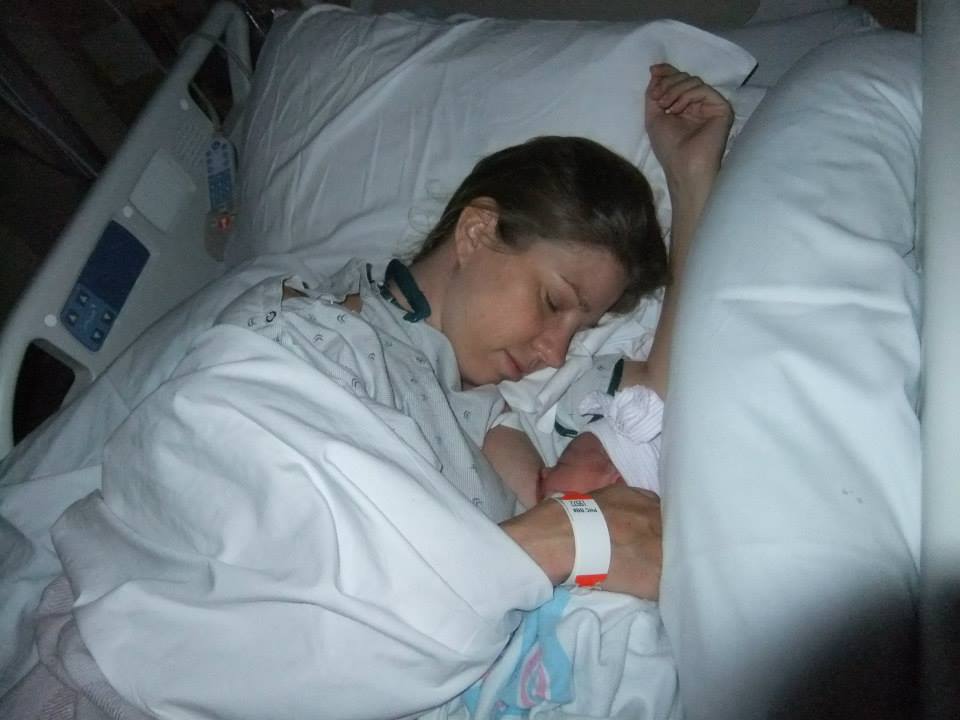
Finally, after over 3 hours the baby was crowning.  Because of the long pushing phase and the difficulty in keeping the fetal heart tones monitored, they called in the pediatric team in case there was a problem with the baby.  The room was full of various personnel who were all in their little corners, chatting casually with one another, and just waiting for the baby to arrive so they could do their job.  In the midst of this the doctor arrived and observed the atmosphere (discussions were going on about what they had for dinner, where they went that past weekend…).  He announced to the crowd “I want the lights dimmed and everyone to be quiet and respectful!  This mom wants a natural, peaceful delivery of her daughter and we are going to give her what she wants!”  You could have heard a pin drop in the room!  The lights were dimmed, the doctor asked for some warm oil and he started massaging the perineum.  With the very next push Jessica made tremendous progress and within 3 pushes the baby’s head was out.  It was at that point, upon seeing her lopsided cone head,  that it became clear that her asynclitic presentation was probably the cause of her slow descent.  With the next contraction the doctor instructed mom to reach down and grab her baby.  Jessica was literally shaking with exhaustion and said “I can’t, I am afraid I will drop her!”  The doctor assured her that he would NOT let that happen and to just grab her baby. 
Picture
There could never be enough words to express the swelling in my heart when I watched my exhausted daughter reach down and pull her daughter out of her body and up to her chest!  I had a new level of respect for my daughter!  The pediatric team was quickly dispatched out of the room as it was immediately obvious that the baby was doing great.  All she needed was a little skin to skin time with mom.  Thankfully, this was at a hospital that has already obtained the “Baby Friendly” certification so they were not trying to hasten the separation of mommy and baby. 

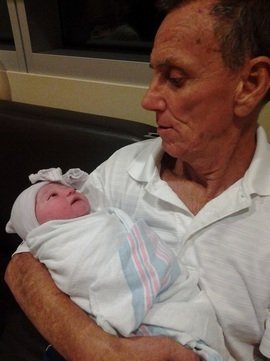
At this point I was able to kind of take a back seat and just observe the new mommy and daddy reveling in their new roles.  Baby stayed on mommy’s chest while the doctor waited patiently for the cord to stop pulsing.  It was quite something to observe.  This long awaited baby was here and being loved on by her new parents.  I could not help but think back to the births of my own children 40, 38 and 33 years ago.  So much has changed since then, but so much is still the same.  My daughter had managed to achieve a hospital birth that was very close to the home birth that I had experienced at her own birth 38 years prior.  In my job as a doula, I know that the birth of the baby usually signals the beginning of the end of my relationship with this new family.  This was so different.  I knew that this was just the beginning of a lifetime of love that I would be able to shower on this baby and her parents!
Picture
PS:  Some of you may question the fact that I do not mention dad much during the labor and delivery.  Let me assure you that dad was very much there and involved in the process.  This family has a unique circumstance where daddy has some severe disabilities in his legs due to burns he suffered many years ago.  He is very limited on the amount of standing he is able to do.  So, while dad was there and contributed very much to the emotional support of his wife, I was the one who provided most of the physical support to my daughter during her labor and the birth of her baby.  

Picture
Karen is a mother, grandmother, and doula. She had a home birth in 1975 with a chiropractor attending. Karen is a Christian who doesn't think God made any mistakes with the way He designed women's bodies. Ever the caretaker, she has an adult, adopted developmentally-disabled brother who she helps care for. Karen loves to sew and cook, but she hates to clean up after both!  Reyelle is her 5th grandchild. Find her on Facebook to learn more about her doula services.  

0 Comments

Day 11: Nova Doula's 52 Weeks of Motherhood Project

5/11/2025

0 Comments

 
Picture
I came across Samantha's project early in the year, and of course, intrigued, I emailed a submission. I love blogs, and projects, and drawing out stories from others...there is such value in what we have to share. It was natural to invite her to the 31 Days project. Samantha's insights and challenges about motherhood are timely and pertinent -- I hope they get us thinking. 

My husband was the one who came up with the idea for The 52 Weeks of Motherhood Project. We were watching the snow on a cold, cold Cleveland day in December and talking about stereotypes of pregnancy, birth and parenthood that we see everyday. I wanted a platform for real people to share their stories. And my genius partner came up with this idea. I would collect stories from people who have lived experiences of pregnancy, birth, and the postpartum period and I would feature the stories weekly, corresponding to each week of the year. We are now in our second trimester, entering week 18.

The goal of The 52 Weeks of Motherhood Project is to show the reality of the first 52 weeks of motherhood—from conception through the 4th trimester—from the points of view of people who have actually gone through the experience, instead of the idealized or scary images fed to us daily. So far there have been stories of surprise pregnancies, women who feel utterly awesome and others who feel the worst they've ever felt, reactions to the news of twins and a rainbow baby, and a family dog who knew Mom was pregnant before anyone else. I've loved seeing how different people’s experiences are, but how there are still some threads of similarity that weave throughout the stories. All the stories express at least a twinge of both hope and fear, and lots of expectations. There’s also the eternal negotiation of internal and external pulls and pushes. Being focused on and centered in your body, sensing the internal changes that are so subtle but so profound, while simultaneously working and playing and interacting with the “outside” world... has there ever been a pregnant person who hasn't experienced this?
Picture
But over the past months, I've been thinking a lot about motherhood and what it means for individuals and our collective culture, and now I’m trying to take a critical look at the subtle implications of a project like this. I did a little unpacking in a recent post because I wanted to clarify the language I've been using to talk about pregnancy. I wanted to be more purposeful and inclusive. Specifically, I wanted to clarify that I recognize that, so far, these have been stories from women who have wanted to be mothers and who have been able and willing to deal with having a new baby and who have been generally excited about the prospect. First off, this doesn't mean that I think that the concept of motherhood is strictly reserved for those who are born female. Secondly, I need to put it out there that I am a firm believer in the right for pregnant people to decide what to do with their own bodies, and I don’t want the stories I share to imply that every pregnant person needs to think of their growing fetus as a baby or a blessing. My thoughts about this are perhaps made a little clearer in this post. 

That said, my understanding of “motherhood” has evolved throughout this project because I have been simultaneously reading the book Of Woman Born: Motherhood as Experience and Institution, written by Adrienne Rich in 1976, and delving into the feminist research surrounding motherhood that has been published since. I’m struggling to understand the nuances of all I’m reading, but thus far something has become very clear to me: our experiences of being mothers and of mothering our children and families are inextricably linked to patriarchal culture. There is a constant struggle for us to be mothers and to mother in a way that is empowering to ourselves and our children within a culture that has pervasive and highly limiting ideas of what motherhood should look like. This is the context surrounding this project right now, and what I’m exploring mentally and emotionally as I read the myriad experiences of pregnancy and motherhood that have been shared with me. 

As a postpartum doula and a mother myself, I get to see and experience the give and take between the cultural ideals of motherhood and the individual meaning of mothering on a daily basis. In my doula work I strive to create a space for mothers to feel safe and supported so that they can (re)discover their place of power and self-confidence and autonomy. I enter families’ homes with an open, nonjudgmental mind because I don’t want to contribute to the blaming, shaming, and competition that are so common within the cultural discourse of motherhood.

I hope to raise recognition of what postpartum doulas do—we’re not babysitters or night nurses or housekeepers or laundresses, although there are aspects of these jobs that overlap with the role of the postpartum doula. Essentially, our job is to support the mother while she learns how to mother. I believe that mothering isn’t instinctual, but rather learned. (Another way of saying this could be that mothering isn’t a passive endeavor, but actually an active, powerful role.) But it’s not learned by using the left-brain methods of analysis and strategizing and reading every parenting book out there. Instead, I think that learning how to mother (or, rather, how you mother) involves learning about yourself and your baby in an intuitive way.  And the fastest way to do this is to spend time really focused on developing that relationship between you and your child and to stay alert to the creative powers that emerge during the transformative processes of pregnancy, birth, and postpartum change. Postpartum doulas provide the support and attention mothers need as they explore these changes.

I’m excited to see how The 52 Weeks of Motherhood Project grows and evolves. I’m continually collecting snapshots of what motherhood means to each person—whether it’s a written story, a photo, an artistic portrayal, or a mixture of all of these. If you’d like to join the project, send an email to info@novadoulaservices.org  for more information. I look forward to hearing from you and reading about your own unique experience of mothering and motherhood.

Picture
Samantha Walters, MPH, owns Nova Doula & Lactation Services and is a postpartum doula and breastfeeding counselor in Cleveland, Ohio. Her background is in women’s sexual and reproductive health, and she also works as a teen sexual health educator. After living far from her hometown for over 10 years, she is so happy to be back on the shores of Lake Erie and she considers herself blessed to be a part of a growing, thriving birth community. She lives with her husband, 22-month-old daughter, and their funny dog. You can follow her on Facebook and Instagram for #52WeeksofMotherhood updates as well as evidence-based parenting and breastfeeding information, updated daily.

0 Comments

Day 10: A Different Kind of Mother's Day Story

5/10/2025

2 Comments

 
Picture
Trigger -- this is about infant loss. I don't know that this needs prefacing. All I can say is -- Michelle, thank you for sharing your Amos with us. Mother's Day blessings to you, and to all who have a child they are thinking about and not able to hold on this day, and all other days. My heart is with you. 

Have you ever thought that you could experience a loss? Or that someone you know could? I didn't.  I was one who never thought loss would happen to me. I knew it happened, but not to me or anyone I knew.

My doula journey started in 2013 when a friend asked me to be her doula. I wanted to learn everything I could about being the best doula I could be for her. I took my training in July of that year and found my heart is birth. I love being with women during this time in their life...so much strength. I love witnessing the birth of a family. 

Fast forward a few months and I found a training I had not heard of in my searching. This training promised certification in birth and bereavement.  I thought about it and felt this would be a great extra tool for my doula bag. Remember, I never thought loss would happen to anyone I knew, including my clients.  But I wanted it just in case.
July 2014 I started my birth and bereavement training through Stillbirthday. I also found out our family was expecting a new baby. I contemplated postponing my training as is it an 8-week intensive training, and for most of that time, I would be enjoying morning sickness.  I decided to go forward, a decision I will never regret. This training is amazingly intense. There were nights of tears while working through my course work. So much pain is discussed.  Our 4th baby was early and had to stay in the NICU -- and although things worked out, certainly it was one of the most painful experiences of my life. I did not expect that pain to be helped by this training, but when we covered the material about babies and NICU stays, some of my pain was smoothed over.

In February, we passed the gestational age of our NICU baby, and I finally let out that held breath. I celebrated and bought my little Amos his first Easter outfit. I was so excited to meet this little man. I had become certified with SBD in December and was looking for a way to provide a support group to our community. Not having much luck, I decided to table it until my little man was born and I was recovered.

Finally, we were 4 days from Amos' due date and labor started. We were so excited. Then things changed quickly. This is when you hear the words you never thought you could hear, you never believed you would hear: "Michelle, I'm not seeing any movement and we aren't hearing any heartbeat." In that moment, things changed forever.
Picture
I was sent to the hospital for an immediate induction. I was blessed with caring nurses I knew from doula work, my midwife, and even the doctor-on-call -- when I requested Chapstick and there was none to be found, she brought me a new stick right from her own purse. It may seem like a small thing, but tender mercies are all we have in moments like this -- and at the time, it meant everything.

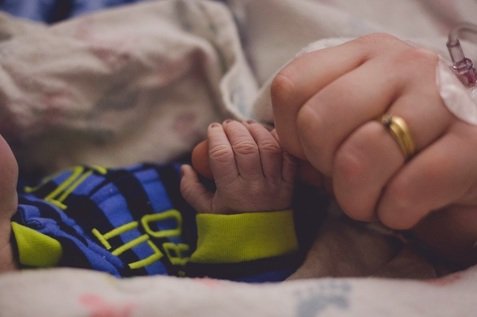
Soon it was time to push. I will never ever forget this part. It's burned into my brain. He was born, and for a brief second, he looked alive. He looked a breath away from life. He didn't move or cry. A caring nurse had said previously one thing that bothers parents the most in situations like these is the silence. She was right -- the silence was deafening; for the first time in my life I understood that saying. In my heart I begged him to breathe. I was screaming for a miracle.  I sobbed and cradled my little Amos. He was perfect. Lots of hair that was a shade of red between his sister's strawberry blonde and his brother's bright red. He never cried, breathed, or opened his eyes. 

My son was born sleeping, and without my training, our hello/goodbye would have looked very different.
Picture
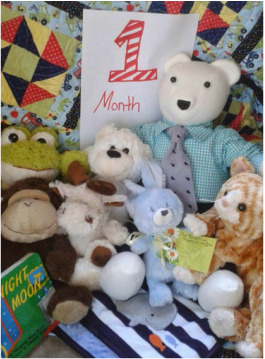
One thing I can say, if a situation like this ever comes into your life -- take pictures. You may not want to see them now, but the memories slowly fade. I am so grateful for the nurses who took pictures, let us borrow their cameras, and the photographer who came to take professional pictures for us. I would not remember his perfect toes, or the shape of his brow, if we had not taken pictures. We asked our other children if and how the wanted to meet Amos. They all wanted to hold him, to see him. Amos is their little brother, and like a shooting star, he was here for just a short time, but his spirit and love remain a bright light in our family. 
Picture
I must stop and tell you about the founder of Stillbirthday, Heidi Faith. This woman -- there are no words to tell you the beauty of this woman's heart. This mama experienced her own loss and has brought beauty from those ashes. I will be planning a trip just to hug this woman as soon as I can. She is my sister. I gained so much more than just an organization. I gained a sisterhood. These women are so beautiful -- most experiencing their own losses and turning around to support others through loss. I can't tell you how much love I have received from these women, from gifts to words and prayers. I have so many to hug. 
Picture
I learned through my Stillbirthday sisters about a piece of equipment called a Cuddlecot. It is a special piece of equipment that can be placed in an infant bed or cradle to extend a family's time with their babies born still. By cooling the infant's body, it delays the inevitable tissue breakdown. This gives family's the gift of time -- more time to say goodbye. I did some research and found US CuddleCot Campaign Initiative is working to get at least one unit in every hospital in America.  I've decided to raise funds to donate a CuddleCot in Amos' name to the hospital where he was born -- I want to do this on his 1st birthday. I'm currently working on a nonprofit fund in his name to help raise the funds and to continue providing support to bereaved families. 
Today marks not only Mother's Day, but also the two-month birthday of Amos. How can one feel so full and so empty, at the same time? What now? I still have a lifelong journey as the mother of Amos and now protecting his memory. I have started. My hope is my son will be remembered, not for his short life, but for how he helped his mama help so many others. I miss my son and I always will, but he brought my doula journey to a whole new level.  I love you, Amos!

Picture
Michelle is a doula and a certified StillBirthdayDoula serving the Northwest Iowa, Southeast South Dakota, and Northeast Nebraska areas. Her heart was pulled toward supporting families through loss before her experience with Amos -- and now she knows with a certainty, she has important work to do in this field. She and her husband and 4 other children talk of Amos often and honor his memory in their own ways. You can follow Michelle's poignant journey on her blog, and find her professional page on Facebook. Click here to learn more about the Amos Fletcher Fund. 

2 Comments

Day 9: The Gift of Life

5/9/2025

1 Comment

 
Picture
I have been a couple of days ahead of these 31 days' posts. Yesterday, on day 8, I was ready through Tuesday, including a special Mother's Day post for day 10. All I needed to do upon waking up today was hit "publish" for day 9's post. 

I was called to a laboring mom in Tulare at 2 am, yet I knew I could use my website's mobile app to publish from the hospital -- but not so, I kept getting an error message (while mom was being triaged in a Visalia hospital and I was in the waiting room). I finally gave up and focused on this birth, knowing I could figure it out later.

This birth! This birth was amazing. My friend and fellow doula, Denise, asked me to support her during her surrogacy birth. Her husband, Chris, was a huge helper -- after all, he has supported her through her natural births before. That left me wondering, what would my place be when the partner is already doing great? I did doula the dog while we labored at their house; poor Buddy had been hiding under the bed until I arrived. I walked in to lay my hands on Denise's back to let her know I was there, and from under the bed, something began licking my feet. Buddy!

What we couldn't predict was, once we got to the hospital, Chris started feeling very sick to his stomach. He needed to go to the car and rest for a while, and he was kind of in and out of the scene. When he was present, he was very present, offering everything he could to support Denise (and the way they worked together was inspiring). And when he needed to step out, he knew things would be okay. 

Denise had an amazing midwife, Rita. Rita is a powerhouse. She had five children of her own, and when she enrolled in a midwifery program Stanford offered for three years back in the 80s, she was pregnant with her 4th baby. Many doubted she would finish, but Rita is nothing if not relentless! And this shows when it comes to supporting her patients. Not only did she go to bat for Denise's comfort and preferences, she also knew how to talk to Denise to keep her courage up and help her move forward when she hit emotional and physical walls. 

The intended mother was at the birth, and she quietly witnessed the whole thing, very concerned for Denise's safety and comfort. When this little baby girl was finally born, she was laid on Denise's chest, with her mom right there, awestruck and deeply moved. I don't think any one of us in the room had dry eyes. Soon the mother sat down in a rocking chair and baby was placed skin-to-skin with her. We all watched this new mother interact with her baby -- the sweet words, the lilting voice, the facial expressions and the snuggling; it was an amazing peek into the private world of a mom and her infant. Soon the new dad joined mom and baby, and again, the tender voices and touches were sweet affirmations to those present that this new gift was one worked hard for, one cherished. 

I didn't intend for this to be anything more than a short Day 9 post to stay on track, but it is hard to withhold the beauty of birth -- every birth. I am amazed at Denise's strength and her generosity. She truly went through one of the hardest physical and emotional experiences in her life to grow and birth a baby for a family who did not have this ability. Four hours or so after the baby's birth I finally left, but one of Denise's last comments to me was this: "I am so grateful I could do this for them."

And I am amazed. 
Picture
1 Comment
<<Назад
Вперед>>

    My Life...

    ♥  four young boys and a boy dog (offspring)
    ♥  partner-in-crime (husband)
    ♥  
    families, mamas, and babies (many of whom are new to earth)

    Categories

    All
    31 Days
    31 Days 2015
    ACOG
    Adoption
    Affordable Care Act
    Anatomy
    Animals
    Anxiety
    Appreciation
    Art
    Babies
    Baby
    Bakersfield
    Batman
    Bias
    Birth
    Birth Center
    Birthplan
    Birth Story
    Birth Team
    Bob Marley
    Bonding
    Books
    Breastfeeding
    Breastfeeding Laws
    Breastfeeding Usa
    Breastmilk
    Breastpumps
    Business
    Cary York
    Cavities
    CBE DIY
    Certification
    Cesarean
    Chico
    Childbirth Education
    Choice
    Chronic Illness
    Cims
    Class
    Clients
    Comfort
    Confidence
    Costco
    Cows
    Dad
    Dancing
    Dentist
    Depression
    Dermatologist
    Dilation
    Doctor
    Domperidone
    Dona
    Doula
    Doulas
    Dr. Brian Palmer
    Drugs
    Due Date
    Due Date
    Ecstasy
    Empowerment
    Enloe
    Epidural
    Experience
    Failure To Thrive
    Failure-to-thrive
    Faq
    Faqs
    Fear
    Fear Tension Pain
    Fees
    Frenectomy
    Frenotomy
    Gratitude
    Green Baby Expo
    Handouts
    Hanford
    Healing
    Henci Goer
    HM4HB
    Holy
    Homebirth
    Hospital Birth
    Hygeia
    IBCLC
    Induction
    Infant Massage
    Insurance
    Interventions
    Interview
    Jaundice
    Journal
    Kids
    Labor
    La Leche League
    Lamaze
    Language
    Late Term Preemie
    Leonard Cohen
    Lip Tie
    Liquid Trust
    Love
    Low Milk
    Mammals
    Media Resources
    Meeting
    Memes
    Midwife
    Midwives
    Milksharing
    Mini Cooper
    Miscarriage
    Mizuko Kuyo
    Moms
    Motherhood
    Moving
    Music
    Networking
    New Doulas
    New England Journal Of Medicine
    Notebook
    Notes
    Nurses
    Ny Marathon
    Online Support
    Orgasm
    Overdue
    Overpowerment
    Oxytocin
    Pain
    Partners
    Passion For Birth
    Paula Radcliffe
    Peanut Ball
    Peers
    Pitocin
    Poem
    Popsicle Panniculitis
    Postpartum
    Premature
    Pushing
    Questions
    Rebirthing
    Rebozo
    Reflux
    Reimbursement
    Retained Placenta
    Rockabye Baby
    Root Canal
    Rules
    Scale
    Second Stage
    Sexual Trauma
    Sheep
    Skin Cancer
    Socks
    Solids
    Spiderman
    Stages Of Labor
    Stillbirth
    Strong-ties
    Students
    Superhero
    Support
    Surrogate
    Teaching
    Teaching Tips
    Teeth
    Temper Tantrums
    The Price Is Right
    Tiara
    Tongue Fu
    Tonguetie
    Tongue Tie
    Tongue-tie
    Training
    Trust
    Tulare
    Vbac
    Visalia
    Waterbirth
    Weak-ties
    Weezer
    Weight
    WHO Code
    Writing
    Yoga

    Archives

    March 2016
    February 2016
    January 2016
    December 2015
    November 2015
    October 2015
    September 2015
    August 2015
    July 2015
    June 2015
    May 2015
    March 2015
    February 2015
    January 2015
    December 2014
    November 2014
    October 2014
    September 2014
    August 2014
    July 2014
    June 2014
    May 2014
    April 2014
    March 2014
    February 2014
    January 2014
    December 2013
    November 2013
    September 2013
    July 2013
    June 2013
    April 2013
    March 2013
    February 2013
    January 2013
    June 2012
    May 2012
    June 2011
    January 2011
    November 2009
    August 2009
    June 2009
    May 2009
    April 2009
    March 2009
    February 2009
    January 2009
    December 2008
    November 2008
    October 2008

    RSS Feed

Stacie Bingham, LCCE, CD(DONA)
Support for the Year Surrounding Birth
Lamaze-Certified Childbirth Educator
​DONA-Certified Birth Doula
LLL-Accredited Breastfeeding Counselor
Serving the Bakersfield & Visalia areas
661.446.4532 | stacie.bing@gmail.com

✕